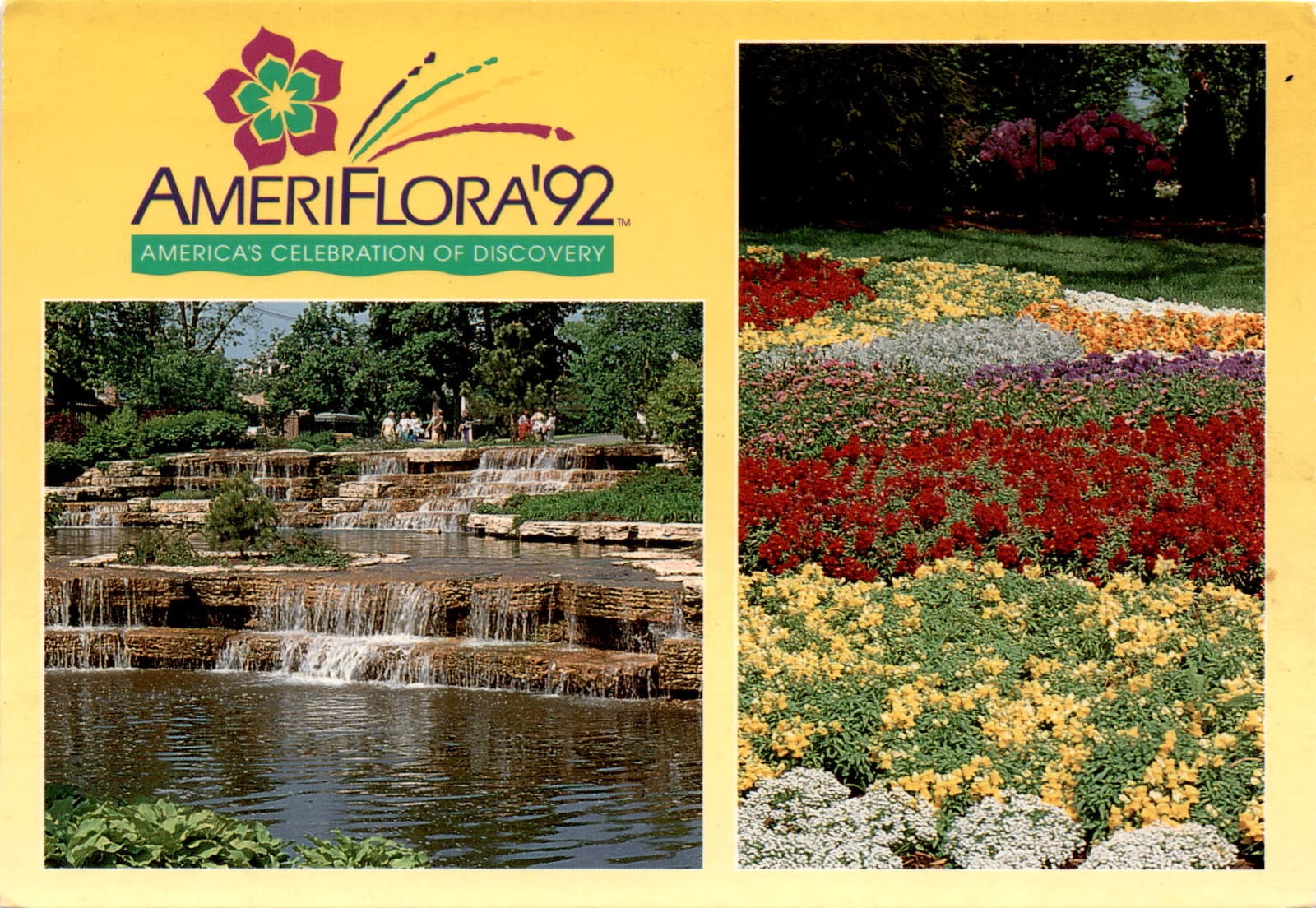
AmeriFlora '92: Columbus Garden Festival History
AmeriFlora was established on November 14, 1986, and in 1989 it was recognized as an official 1992 commemorative event by the United States Christopher Columbus Quincentenary Jubilee Commission. The organizers aimed to draw national attention and give the otherwise quiet city a spot “on the map.”
Touted as the first International Floral and Garden Exhibition in the U.S., it brought together central Ohio residents, event planners, and horticultural experts who began planning in the mid-1980s. By 1992, the team had grown to over 200 full-time staff members.
Franklin Park was part of AmeriFlora's bid for use of the site. It required not only cleaning it up for the exposition but removing all traces of the event and returning it to the city as a public park.

Franklin Park Conservatory
The Franklin Park Conservatory, built in 1895 and inspired by the Glass Palace from the 1893 World's Columbian Exposition in Chicago, stands proudly on its grounds. A $16 million renovation and expansion turned the Victorian landmark into the highlight of AmeriFlora and Franklin Park. Today, the Franklin Park Conservatory and Botanical Gardens is a beautiful destination in Columbus, Ohio, located at:
1755 E. Broad St., Columbus, Ohio 43203.
Hours of operation:
7 a.m.-11 p.m.
Parking at Franklin Park is available in lots located off E Broad St and Franklin Park W.
It is open daily, and an admission fee is charged. Today, it is a horticultural and educational institution showcasing exotic plant collections, special exhibitions, and Dale Chihuly artworks.
The conservatory contains more than 400 plant species. Biomes representing global climate zones include:
. Himalayan Mountains,
. Tropical Rainforest,
. Desert,
. And Pacific Island Water Garden.
. Additional plant collections include a Bonsai Courtyard, Showhouse with seasonal displays, orchids and tropical bonsai collections, and Palm House with more than 40 species of palms. The conservatory is set within the Franklin Park neighborhood, and surrounded by Franklin Park, the 88-acre city park of the same name.
Built in 1895, the conservatory was listed on the National Register of Historic Places in 1974 and became part of the new Columbus Near East Side District in 1978.
In 1852, the Franklin County Agriculture Society bought 88 acres of land just two miles east of downtown Columbus to host the first Franklin County Fair. By 1874, recognizing its value, they expanded it to 93 acres and officially designated it as the site of the Ohio State Fair.
The state fair was held on the site until 1884, when it moved to a new location north of Columbus, leaving the lot abandoned. Then, on May 17, 1886, the Ohio State Legislature officially brought it back to life by declaring it open for use as a public park.
In 1893, the Chicago World’s Fair and Columbian Exposition was a hugely influential social and cultural event. It inspired Columbus to build a horticulture hall modeled after the fair’s Glass Palace. This grand Victorian-style glass structure was constructed in Franklin Park and opened to the public in 1895 as the Franklin Park Conservatory.
From 1895 to 1989, Columbus Recreation and Parks Department owned and operated the conservatory. Unfortunately, little is known about the conservatory's earliest days, as a fire in Columbus City Hall destroyed its records in 1921. Much of the conservatory's history has been documented from newspapers and personal written accounts.
For a short period starting in 1927, animals were kept in the lower rooms of the conservatory. In 1929, these animals left the conservatory and became part of the first Columbus Zoo and Aquarium.
Over the years, the facility earned a reputation for its outstanding horticulture and its collection of rare, unique plants. The conservatory also grew into a favorite spot for family gatherings, weddings, and other special occasions.
In 1974, in recognition of the conservatory's historic and architectural merit, the original glass structure, today known as the Palm House, was listed on the National Register of Historic Places.

Ameriflora '92
In 1992, Columbus hosted Ameriflora '92, selecting Franklin Park and its conservatory as the venue for the six-month international horticultural exposition. Renovations to the historic Palm House and a $14 million expansion kicked off in 1989, adding 58,000 square feet to the conservatory with new plant collections, classrooms, a library, gift shop, café, and administrative offices.
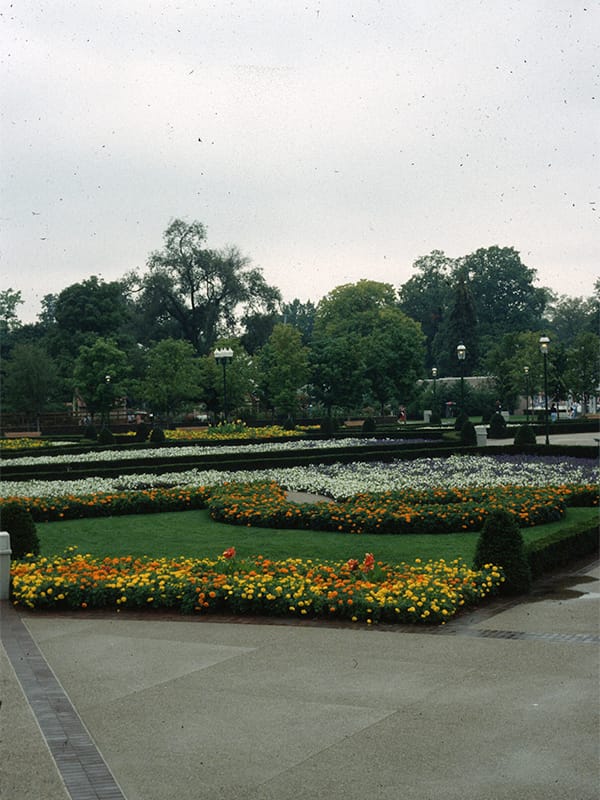
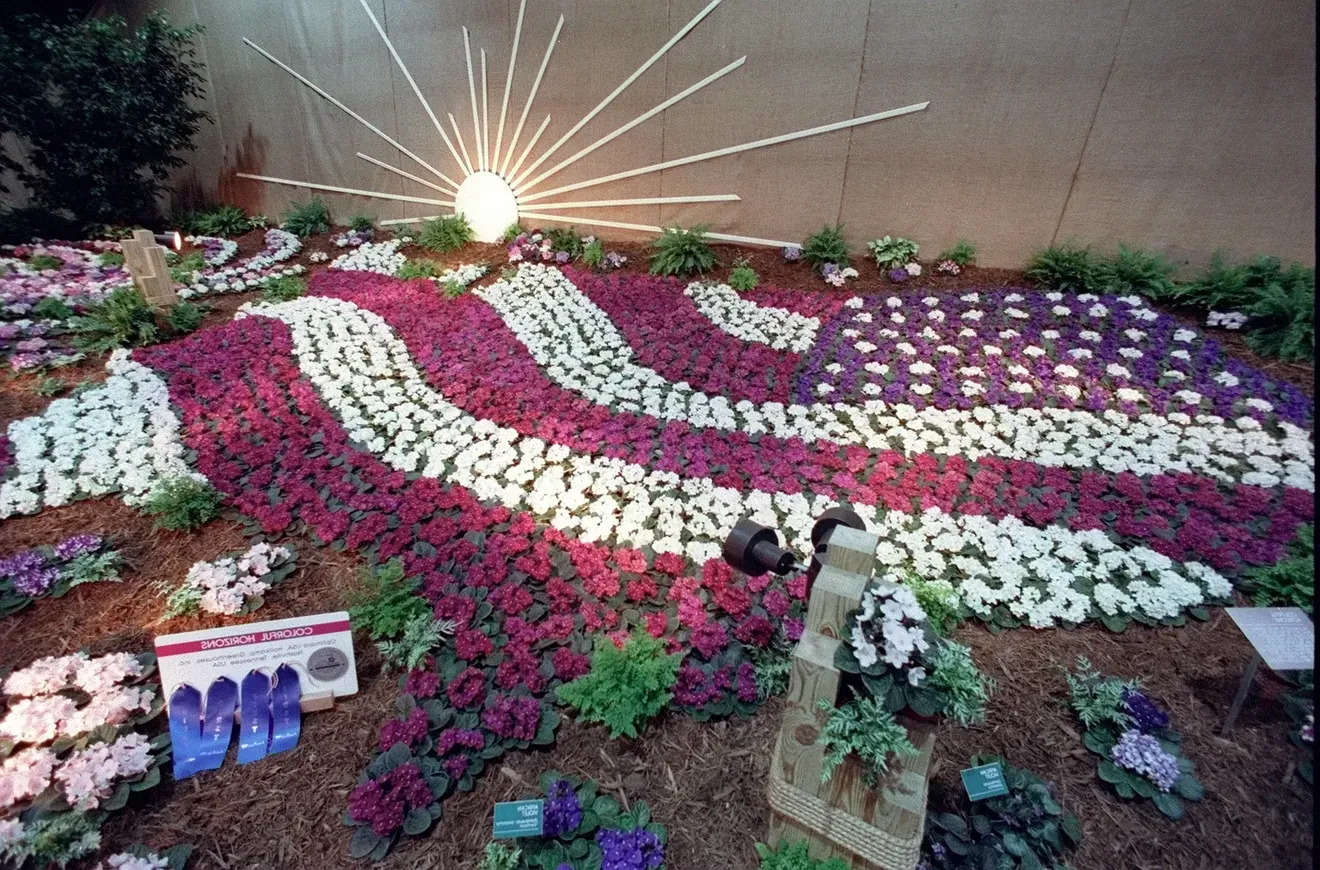
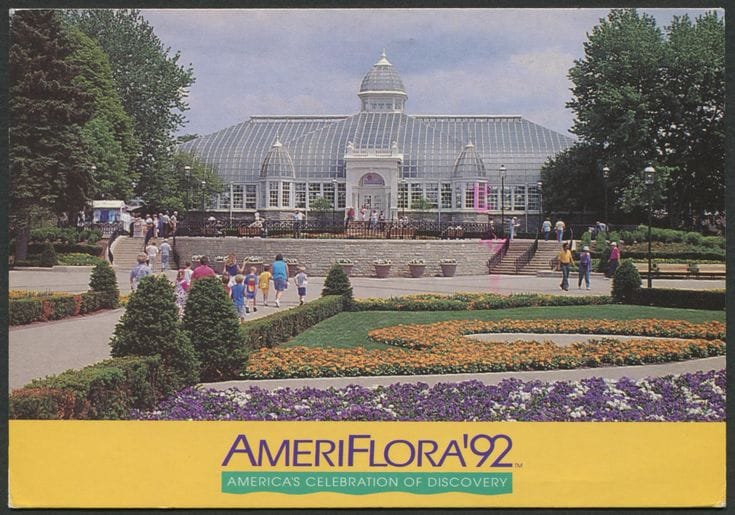
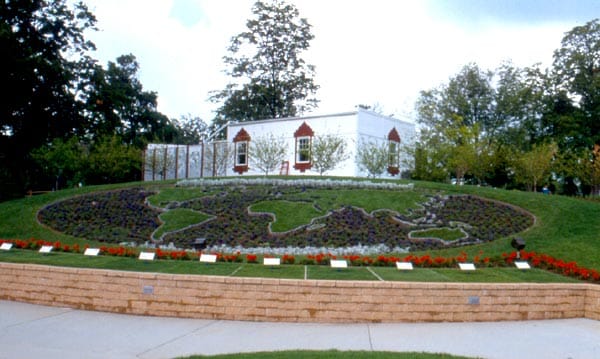
After AmeriFlora, the future of Franklin Park Conservatory was uncertain. To ensure its long-term management, the Ohio Legislature established the Franklin Park Conservatory Joint Recreation District. The conservatory and its surrounding 28 acres were handed over to a new 10-member board of trustees and an executive director. With a small but dedicated team of staff and volunteers, and a $500,000 operating budget, the institution began to rebuild its identity and momentum.
The Topiary Park in downtown Columbus was also created as an exhibit for the festival. Check out my recent blog on the Topiary Park.

Why AmeriFlora '92 Was Not an Economic Success
Despite years of heavy publicity and marketing, AmeriFlora failed to draw enough visitors to cover expenses, especially as costs soared even before the gates opened.
Also cited as reasons for low attendance were:
. Torrential rain of about 14 inches in July that flooded the lagoons,
. A lack of interest from the surrounding black community,
. A boycott by Native Americans due to its celebration of Christopher Columbus,
. The exhibition's unclear image as a flower show vs. as a theme park, a lack of enthusiasm for it by professional horticulturalists,
. And its $20 admission which would be$45 in 2024.
What was originally planned to be a two-week floral festival evolved into a six-month extravaganza, with the idea being that more tickets could be sold in 26 weeks than two. As operating costs mounted and corporate sponsorships failed to materialize, the attendance projections—and ticket prices—rose accordingly.
After the costly flop of the 1989 Son of Heaven Chinese art show, which left city and state governments covering $1.6 million in losses, AmeriFlora’s organizers took a different approach. They secured $33 million in public funds before the event even began. But when AmeriFlora underperformed, The Columbus Dispatch stepped in with a $2.6 million check to turn the 88-acre site into a promised public park. While an escrow account was set up for the funds, part of the money was expected to come from ticket sales, which fell short. John F. Wolfe, publisher of the Dispatch, also happened to be President of AmeriFlora’s Board of Trustees.
AmeriFlora closed on Columbus Day 1992, but the cleanup, demolition of buildings, and conversion of the grounds into a public park extended into the winter months. Franklin Park Conservatory became the property of the non-profit Franklin Park Joint Recreation District, which still operates the facility today.
Conclusion
I remember the AmeriFlora '92, but I didn't get to visit it. It was too expensive at the time for my family. However, my husband was able to go on field trips with our sons to visit AmeriFlora. It is a shame that more people didn't get to enjoy it because of the cost.
Today, Franklin Park is a very beautiful park with plenty of room to walk and plenty of shade during the hot summer months. There is not an official hiking trail, but the area is a nice place to walk with plenty to see.
The conservatory is still there and is open with entry fees that vary by day and season. For example:
Wednesday, December 17, 2025
Daily Admission: All In Public Pricing
- Adult $24 + Culture Fee $1.20= $25.20
- Senior $20 + Culture Fee $1.00 = $21.00
- Child (3-12 yrs) $16.50 + Culture Fee $.83 = $17.33
The entry to Franklin Park is free.
Go visit Franklin Park, you won't regret it!