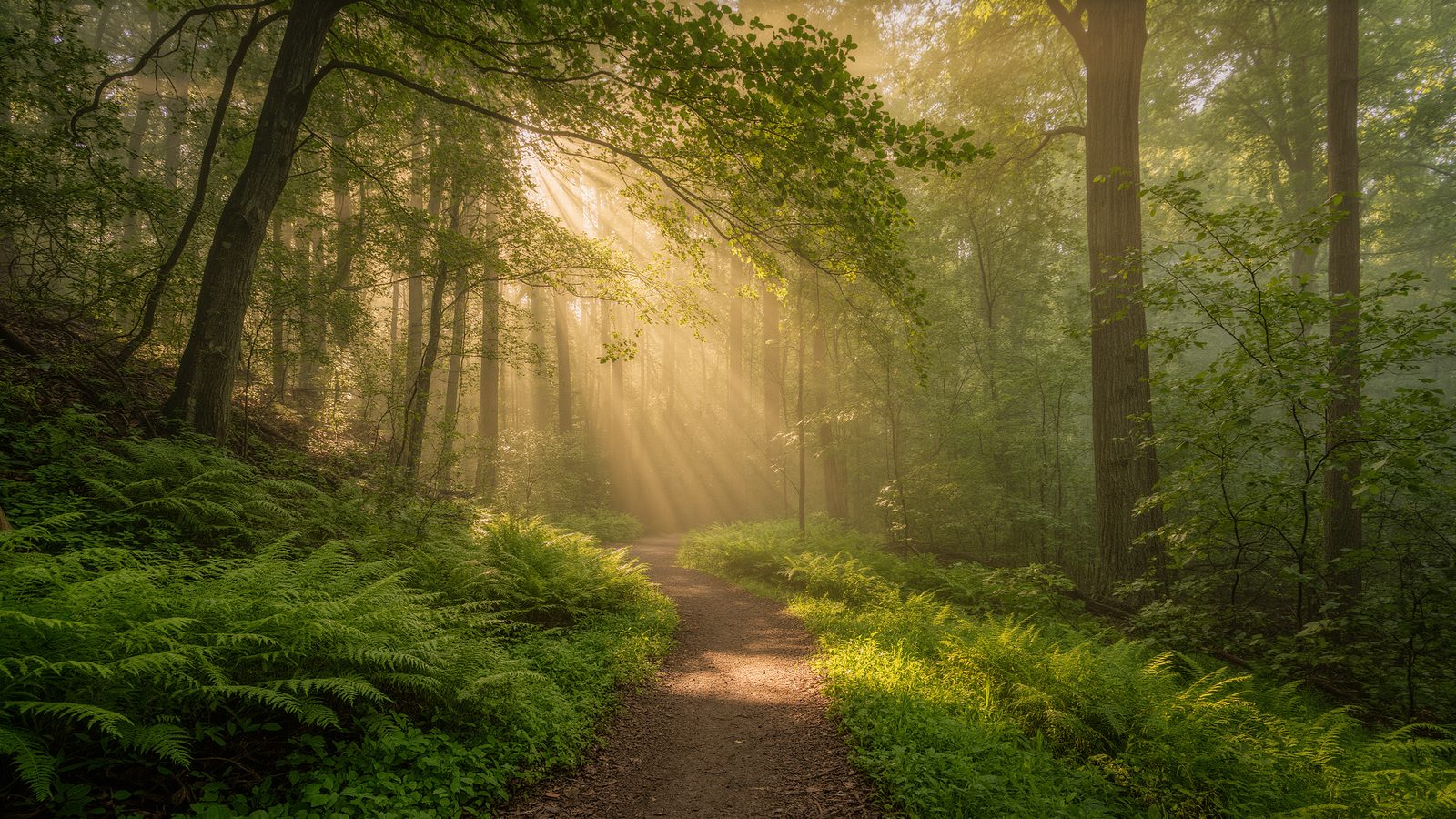
Summer Hiking in Ohio: Heat, Humidity, Ticks, and Staying Safe
Ohio summer doesn't announce itself with drama. There's no altitude to worry about, no exposure, no afternoon monsoon rolling off a mountain. What we have instead is a thick, soupy, deceptively draining kind of heat — eighty-five degrees with humidity to match, the air sitting heavy under a green canopy, the trail closer and stickier than the temperature alone would suggest. I've watched people who'd happily hike all day in October get genuinely worn down by a flat three-mile loop in July, simply because they didn't respect what Ohio humidity does to a body.
The good news is that summer is a wonderful time to be out on Ohio trails. The forests are at full, dripping green. The creeks and waterfalls are running. Evenings stretch long and golden, and the canopy that makes the air feel close also throws deep, cool shade over the best trails. You just have to hike summer a little differently than you hike spring or fall, and you have to know what's out there with you — the bugs, the plants, and the small handful of things that can actually hurt you. None of it is exotic, and none of it should keep you home. It just rewards a little preparation. Here's how I handle an Ohio summer on the trail, after a lot of sweaty miles figuring it out the hard way.
The Real Enemy Is Heat and Humidity
Let's start with the thing that actually sends Ohio hikers home early or worse: the heat. We don't get the dry, brutal heat of the desert Southwest. We get wet heat, and wet heat is sneaky because your sweat doesn't evaporate efficiently in humid air, which is exactly how your body is supposed to cool itself. So you keep sweating, you keep losing water and salt, and your core temperature creeps up anyway. That's the road to heat exhaustion, and on a bad day, heat stroke.
The fixes are simple and I follow them religiously from June through August:
Hike early. This is the single best thing you can do. A 7 or 8 a.m. start gets you the cool of the morning, the best wildlife activity, and a finish before the worst of the afternoon heat. The same trail at 8 a.m. and 2 p.m. is two completely different experiences in July.
Drink more than you think you need, and add electrolytes. Plain water is necessary but not sufficient when you're sweating hard for hours — you're losing salt too. I carry more water than the distance seems to call for and drop in an electrolyte tab or mix on the hot days. If you're cramping or getting a dull headache, you're already behind.
Pick shaded, watered trails. Summer is the season for ravine and gorge hikes, creekside trails, and deep-woods loops. Save the open prairie and the exposed ridgeline for spring and fall. A shaded trail along moving water can feel ten degrees cooler than a sun-baked field a quarter mile away.
Know the warning signs. Heavy sweating that suddenly stops, dizziness, nausea, a pounding headache, confusion, or skin that's gone hot and dry — those are stop-now, get-to-shade, cool-down-and-rehydrate signals. Don't push through them. Heat illness escalates fast.
Ticks: The Thing to Take Seriously
If I could get every Ohio hiker to change one habit, it'd be tick checks. Ticks have expanded their range across Ohio significantly over the last couple of decades, and they're no longer a "down south" or "deep woods" problem — they're in the metro parks, the grassy edges, the brushy trailsides right outside Columbus.
Ohio hosts three ticks worth knowing:
- The blacklegged tick (the deer tick) is the one that can carry Lyme disease. It's small — the nymphs are poppy-seed tiny — and it's the reason careful tick checks matter.
- The American dog tick is larger and can transmit Rocky Mountain spotted fever.
- The lone star tick, identifiable by the single white dot on the female's back, has moved north into Ohio and can cause ehrlichiosis and the strange red-meat allergy known as alpha-gal syndrome.
You don't need to be afraid of the woods. You need a system:
Treat your gear with permethrin. This is the heavy hitter. Permethrin sprayed on boots, socks, and pants (not skin — it's a clothing treatment) actually kills ticks on contact and lasts through several washes. It's the closest thing to tick armor there is.
Use repellent on skin, DEET or picaridin, especially around the ankles and lower legs where ticks climb aboard.
Dress defensively on brushy trails — long pants, socks pulled up, light colors so you can spot a crawler before it digs in.
Check, every time. When you get back to the car or home, do a real check: behind the knees, the waistband, the hairline, the armpits, behind the ears. A tick usually has to be attached for many hours to transmit disease, so finding and removing it promptly with fine-tipped tweezers — straight out, steady pressure — is genuinely protective. Don't burn it or smother it; just pull it cleanly.
Poison Ivy: Learn the Leaf
"Leaves of three, let it be" is a cliché because it works. Poison ivy is everywhere in Ohio — trailside, climbing trees as a hairy vine, sprawling as ground cover — and the urushiol oil in every part of the plant gives most people a miserable, itchy, blistering rash.
Learn to recognize it: three leaflets, the middle one on a longer stalk, the leaf edges sometimes smooth and sometimes toothed (it's variable, which is what makes it tricky), often glossy, reddish in spring and turning brilliant in fall. When in doubt, stay on the trail and don't grab trailside vegetation to steady yourself. If you do brush it, washing the oil off with soap and cool water within a couple of hours can head off or reduce the reaction — the oil is the problem, and it doesn't soak in instantly. And if you hike with a dog, remember the dog can carry the oil home on its fur and give you the rash secondhand.
Mosquitoes, Storms, and Ohio's Few Venomous Snakes
Mosquitoes love the same wet summer woods you came to hike. The same DEET or picaridin repellent that fends off ticks handles them. Dawn and dusk near standing water are the worst, so plan accordingly.
Thunderstorms are the summer weather hazard. Ohio afternoons can build pop-up storms in a hurry, and the lightning is the real danger — not the rain. Check the forecast, watch the sky, and if you hear thunder, it's time to get off exposed high ground and out from under isolated trees. The morning-start habit dodges most of this too, since storms tend to fire in the afternoon heat.
Snakes worry people more than they should. Ohio has only three venomous species, and all three are uncommon to rare: the Eastern copperhead, the timber rattlesnake, and the Eastern massasauga. You're most likely to maybe encounter a copperhead, and only in the rocky, wooded, unglaciated hill country of southern and eastern Ohio. Across most of the state, and on the vast majority of hikes, every snake you see will be harmless. The rule is the same everywhere: don't reach into rock crevices or step over logs you can't see the far side of, watch where you put your hands and feet, and give any snake a wide berth and the right of way. Snakes want nothing to do with you. Nearly every bite happens because someone tried to handle or kill one. Just walk around it.
Don't Forget the Dog
Ohio is full of dog-friendly trails, and summer is exactly when our dogs are at the most risk and we notice it the least. Dogs cool themselves by panting, not sweating, and that system gets overwhelmed fast in heat and humidity — sometimes before the dog shows obvious distress. A few rules I never break in summer:
Hike dogs early, in the cool of the morning, same as you'd hike yourself. The afternoon heat that wears you down can be dangerous for a panting dog.
Check the ground temperature. Paved trailheads, boardwalks, and sun-baked rock can get hot enough to burn paw pads. The back-of-your-hand test works: if you can't hold the back of your hand on the surface for several seconds, it's too hot for paws. Stick to shaded dirt on hot days.
Carry water for the dog too, and a way to offer it — a collapsible bowl or just a cupped hand. Don't count on the dog drinking from the creek; in summer, slow or stagnant Ohio water can carry harmful algae blooms that are genuinely toxic to dogs. If the water looks scummy, pea-green, or has a paint-like sheen, keep the dog out of it entirely.
Watch for overheating: frantic panting, bright-red gums, stumbling, or a dog that lies down and won't get up. That's an emergency — get into shade, wet the dog down with cool (not ice-cold) water, and head for help.
A Note on Summer Trail Conditions
A couple of Ohio-specific seasonal realities round out the picture. Summer growth means trailside vegetation crowds in — that's part of why ticks and poison ivy are more of a problem now than in winter, and a good reason to stay centered on the trail tread rather than brushing the green walls on either side.
After heavy summer rain, creek crossings rise and rocks get slick. Ohio doesn't have dangerous flash-flood canyons the way the desert does, but a normally ankle-deep crossing can run higher and faster than you expect after a storm upstream, and wet stepping stones send people down hard. If a crossing looks pushy, it's fine to turn around — the trail will be there next week.
And the flip side: summer is peak waterfall and creek season only right after rain. In a long dry July, our smaller falls slow to a trickle. If chasing water is the plan, time it for the days following a good soaking, and you'll catch the gorges at their best.
What I Actually Carry in Summer
A summer day pack for an Ohio trail isn't complicated, but a few items earn their weight:
- More water than feels necessary, plus electrolyte tabs or mix
- Repellent (DEET or picaridin) and permethrin-treated socks and pants
- A lightweight, breathable sun layer and a hat — even in shade, the gaps let UV through
- Fine-tipped tweezers for tick removal, in a small first-aid kit
- A way to check the weather radar before and during, since storms build fast
- Quick-dry everything — cotton stays soaked and miserable in Ohio humidity; synthetic or merino dries and breathes
- A small dry bag or zip-top for your phone and a spare pair of dry socks, because both an afternoon storm and a sweat-through are likely in July
Hike Summer, Just Hike It Smart
None of this is meant to scare you off the trail. Ohio summers are green and alive and worth every sweaty mile — the deep-woods shade, the full creeks, the long light. The hikers who struggle in July are almost always the ones who treated it like an October hike: started late, packed light on water, grabbed the trailside vine to steady themselves, skipped the tick check. Start early, drink more, treat your clothes, learn the leaf, and give the snakes their space, and an Ohio summer becomes one of the best seasons to be out there.
I've come to think of summer as the season Ohio's trails reward preparation the most. In spring and fall, you can get away with winging it — the weather is forgiving and the bugs are quiet. Summer asks a little more of you, and gives more back. The morning you start at first light, beat the heat, and have a shaded gorge trail entirely to yourself while the rest of the county is still asleep is the morning you understand why some of us never stop hiking through the warm months. Respect the heat, the ticks, and the storms, and the rest is pure green Ohio at its best.
More Summer Hiking Reads
- For shaded, watered summer trails, my Ohio waterfall hikes roundup is built for exactly this season.
- Hiking with the family? The kid-friendly Ohio hikes guide flags the shorter, shadier loops that work in the heat.
- Local to central Ohio? Start with the best hikes near Columbus and pick the wooded ones for July and August.
🥾
More in

Hiking During Ohio Hunting Season: 2026-27 Dates and Safety
Ohio's deer seasons overlap the best hiking months. The 2026-27 dates, where hunting happens, what to wear, and where to hike during gun week.
What to Pack for an Ohio Day Hike: A Tested Gear Checklist
A practical day-hike gear checklist for Ohio trails — boots, water, layers, and the safety items that matter, with no overpacking.