Gorge Metro Park: A Cuyahoga River Gorge Near Akron
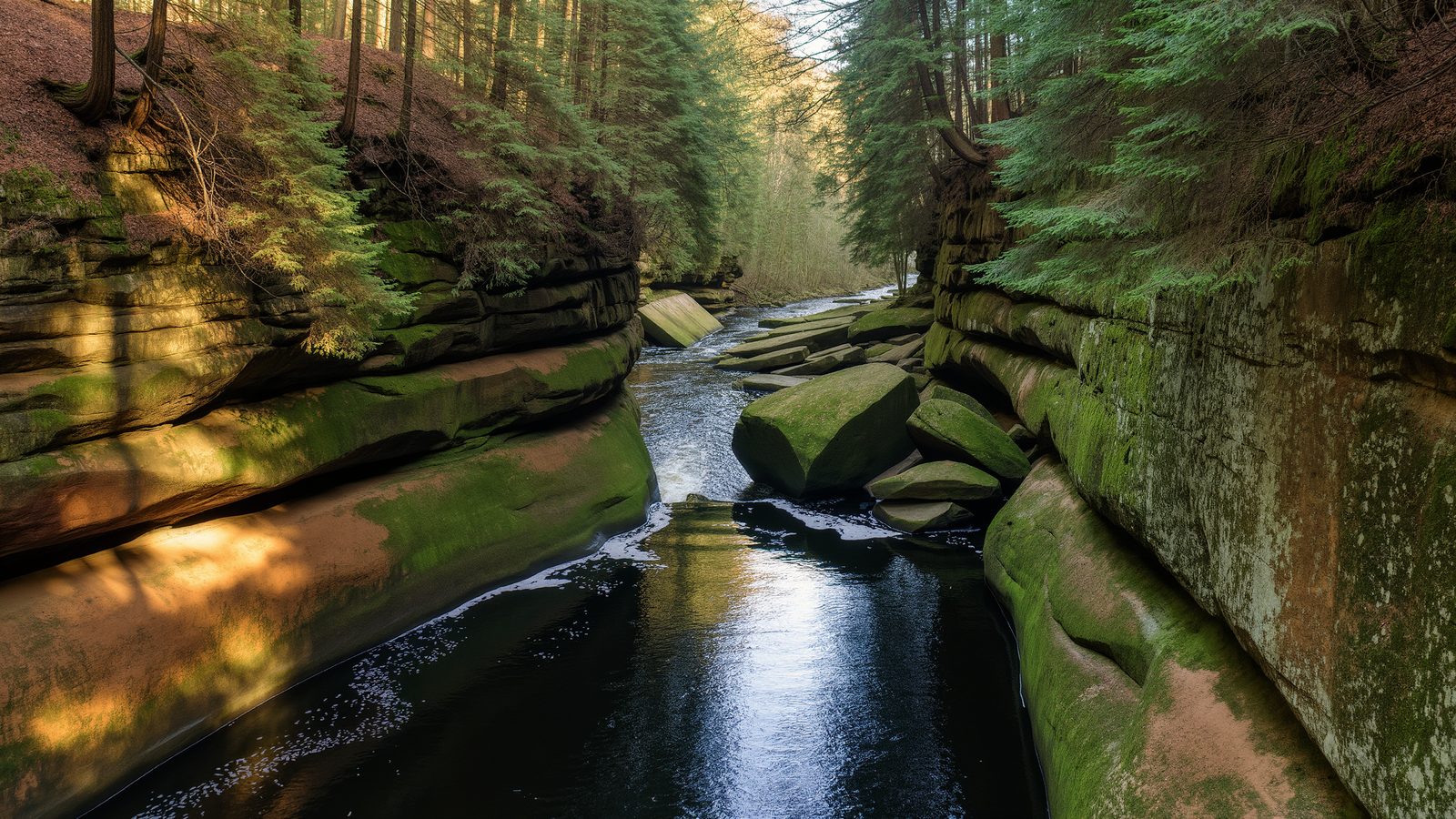
Right in the middle of the built-up strip between Akron and Cuyahoga Falls, where you would swear there is no room left for anything wild, the Cuyahoga River drops into a rock canyon and everything changes. One minute you are in a parking lot off Front Street with traffic behind you. The next you are standing on a ledge of ancient sandstone, hemlocks leaning over black water, house-sized boulders stacked in the gorge below. It is one of the most improbable pieces of trail in Ohio — a genuine river gorge hiding in plain sight in the suburbs.
Gorge Metro Park is one of the crown jewels of the Summit Metro Parks system, and it has been drawing people to this bend in the Cuyahoga for almost a century. The rock ledges hold thousands of years of history. There is a recess cave with a real kidnapping story attached to it, a stretch of river that used to be a Gilded Age amusement park, and, as of this writing, one of the biggest dam-removal projects in the state slowly changing the whole character of the place. It is a short drive off I-77 or Route 8, and it packs more drama per mile than almost any hike its size.
One important note before you go: parts of Gorge Metro Park have been closed for construction tied to the removal of the Gorge Dam. Trail access changes as that work moves along, so check the Summit Metro Parks website for current closures before you drive out. What is open is still very much worth the trip — just confirm the day's conditions first.
Visitor info (as of September 2026, Summit Metro Parks): About 144–155 acres (1930 donation cited as 144 acres; some Summit pages round ~155). Main entrance 1160 Front St., Cuyahoga Falls, OH 44221; Highbridge area 1270 Front St., Akron, OH 44310 (Highbridge Trail area closed during dam/sediment work). Park hours 6 a.m.–11 p.m. Admin/alerts: 330-867-5511. Confirm closures on the official Gorge Metro Park page and alerts.
Trail at a Glance — Gorge Metro Park
- Distance: Gorge Trail ~1.8 miles; Glens Trail ~1.8 miles round-trip (Summit Metro Parks)
- Difficulty: Moderate — rocky footing, stairs, and root-tangled ledges reward careful feet
- Best season: Fall for color in the gorge; spring for high water and flow
- Dogs: Leashed dogs welcome
- Highlights: Cuyahoga River gorge, Mary Campbell Cave, sandstone ledges, huge boulders
- Location: Between Akron and Cuyahoga Falls, Summit County, Ohio
Getting there and where to start
Gorge Metro Park sits right on the Akron and Cuyahoga Falls line, with its main lot off Front Street. From Cleveland it is about forty minutes south; from Columbus, a little over two hours north up I-71 and I-77. Admission is free, like all the Summit Metro Parks. Because the park is wedged into a developed area, the lots are not huge, and on a nice fall weekend they fill up. Come early.
The two trails to know are the Gorge Trail and the Glens Trail. The Gorge Trail is the star and starts right from the main lot. The Glens Trail begins across Front Street and runs along the edge of the river with springs flowing right out of the rock walls. Between construction closures and the sheer drama of the terrain, this is a park where you want a map and a little patience. Read the signs, respect the barriers, and do not go scrambling off-trail onto the ledges no matter how good the photo looks.
The trails
The Gorge Trail is the most popular route in the park, and for good reason. It runs a loop of roughly 1.8 miles that packs an astonishing amount of scenery into a short distance. You start high, walk out along the rim with the river far below, then drop down through the rocks toward the water. The footing is genuinely rocky — stone steps, roots, uneven ledges — so this is a trail for real shoes, not sandals, and it earns its "moderate" rating on terrain rather than distance.
Early in the loop you pass the old concrete dam, an enormous man-made wall that has defined this stretch of river for over a century. A little past it, the trail reaches Mary Campbell Cave (also called Old Maid’s Kitchen on Summit Metro Parks maps), a big recess cave scooped out of the sandstone. Then the route works down among the boulders — some of them the size of small houses, tumbled and stacked where the river and the ice left them — before climbing back up to close the loop. It is the kind of hike where you stop every few minutes because the next rock formation is somehow better than the last.
The Glens Trail across Front Street is also listed at about 1.8 miles round-trip and hugs the riverbank, giving you water-level views and little springs weeping straight out of the cliff faces — when it is open. Between the two, you get the gorge from both the top down and the bottom up. As of September 2026, Glens Trail and portions of the lower Gorge Trail / Highbridge area have been closed for dam-removal sediment work; check alerts before you go.
Mary Campbell Cave and a two-hundred-year-old story
The recess cave along the Gorge Trail is not just a pretty overhang. It carries one of the oldest recorded human stories in this part of Ohio.
In 1759, during the fighting on the Pennsylvania frontier, a young girl named Mary Campbell was taken captive by Lenape — Delaware — people and brought west into the Ohio country. By tradition, she lived for a stretch of her captivity here at this cave along the Cuyahoga, one of the first people of European descent known to have lived in what is now Summit County. She was eventually returned to her family years later. The cave has carried her name ever since.
I always find it a little dizzying to stand at a spot like that. The rock has not changed. The river still runs below it the same way. And the human history layered on top — captivity, frontier violence, a child living under this exact overhang more than 260 years ago — is right there under a sign, a few hundred feet from a suburban parking lot. It reframes what looks at first like just a cool cave.
When this was an amusement park
Here is the twist almost nobody expects. This quiet gorge was once one of the biggest entertainment destinations in northeast Ohio.
In the late 1800s, this stretch of river was known as High Bridge Glens, and it drew crowds by the thousands. There was a park built into the gorge with walkways, a dance hall, overlooks, and daredevil attractions perched over the rapids. When the interurban rail lines came through, the operators leaned into the gorge as a natural draw, and for a while this was where Akron came to play. The Gorge Dam went in around 1912, built for hydroelectric power, and it flooded out the old rapids and slowly changed the river's character for good.
You can still read the bones of that history in the landscape if you know to look — old stonework, the strange scale of a place that was engineered for crowds. The gorge went from wild rapids, to Gilded Age playground, to industrial dam site, to protected metro park, all on the same short bend of the Cuyahoga. Few Ohio trails carry that many chapters.
The dam is coming out
The newest chapter is being written right now. The Gorge Dam — the big concrete wall you pass early on the Gorge Trail — is being removed, in what is one of the largest dam-removal efforts on the Cuyahoga River. The old dam has held back not just water but a deep pool of contaminated sediment for over a century, and taking it out is a massive, careful, multi-year job involving cleaning up that sediment and letting the river run free through the gorge again.
That is why parts of the park have been closed. It is disruptive in the short term, and it means your visit right now comes with fences and detours. But it is genuinely good news for the river. When the work is done, this stretch of the Cuyahoga — a river once so polluted it famously caught fire — will flow through its gorge unobstructed for the first time in more than a hundred years. The rapids the Victorians came to gawk at may well come back. I plan to be there when they reopen the full trail to see it.
The rock is the real story
Strip away the history and the drama, and what you are really walking through is a lesson in deep time written into stone. The gorge is carved out of Sharon Conglomerate, a hard, coarse sandstone studded with rounded quartz pebbles — geologists sometimes call it "puddingstone" because the pebbles look like fruit set in a pudding. Those pebbles were tumbled smooth in ancient rivers something like 300 million years ago, long before the Cuyahoga existed, then cemented into rock and slowly cut back open as the modern river ground its way down through the layers.
That hard conglomerate is why the gorge is so steep and blocky instead of gently sloped. The rock resists erosion, so instead of wearing into a soft valley it fractures along straight lines and topples in enormous rectangular blocks — which is exactly why the bottom of the gorge is a jumble of house-sized boulders. Water seeps out along the seams between rock layers, feeding the little springs you see on the Glens Trail and keeping the shaded cliff faces damp and green.
That cool, wet, shaded microclimate is a haven for hemlocks. These evergreens are relics of a colder era, and they cling to the north-facing gorge walls where the air stays chilly even in July. Walking the lower trail under the hemlocks, next to the seeping rock and the black water, you get a pocket of forest that feels far more northern than a suburb of Akron has any right to. Look for the ferns tucked into the ledges and the moss on the shaded stone — this is a whole small ecosystem living on the fact that the rock keeps the gorge cool.
How I would spend an afternoon here
Because the trails are short, Gorge is an easy park to pair with the rest of a day out in the Akron area, but I would still give it a couple of unhurried hours rather than blitzing the loop. Start early to beat the small-lot parking crunch, and check the closures the night before so you already know which trails are open.
Walk the Gorge Trail loop first, slowly. Stop at the dam, then Mary Campbell Cave, then work your way down into the boulders and let yourself actually poke around the rock formations — this is a park that rewards standing still and looking up at the ledges more than it rewards racking up mileage. When you climb back out, cross Front Street and add the Glens Trail for the water-level view and the springs weeping out of the cliffs. Together the two trails still add up to a modest afternoon, which leaves plenty of day for the falls at nearby Cuyahoga Falls or a drive up into the Cuyahoga Valley. Few short hikes in Ohio give you this much to look at per step.
Tips and seasonal notes
- Check for closures first. This is the big one. Dam-removal construction has closed portions of the park, and access changes over time. Look at the Summit Metro Parks site before you drive out.
- Wear real shoes. The Gorge Trail is rocky, rooty, and full of stone steps. Sturdy footing beats fashion here every time.
- Stay on the trail. The ledges are dramatic and the drops are real. The barriers are there for a reason — the best view is not worth a fall into the gorge.
- Come in fall. The gorge lights up with color in October, and the rock walls frame it beautifully. Spring brings higher water and stronger flow.
- Go early on weekends. The lots are small and the park is popular. Morning gets you both a parking spot and the best light down in the rocks.
Why it is worth the drive
Gorge Metro Park is proof that you do not need to leave the city to find real wildness in Ohio. A true river gorge, sandstone ledges older than anyone can picture, a cave with a frontier story, the ghost of a Victorian amusement park, and a river in the middle of reclaiming itself — all in under two miles of trail, wedged between two Ohio suburbs.
I have brought first-timers here who could not believe this canyon was sitting behind a strip of Front Street the whole time. That is the Gorge effect. Check the closures, lace up real shoes, come in the fall if you can, and go see the most dramatic short hike in northeast Ohio while the river is busy remaking itself.
🥾
Nearby trails to explore
- Cuyahoga Valley National Park: Ohio's only national park, just north
- Nelson Kennedy Ledges State Park: dramatic sandstone ledges and rock scrambles
- Mohican State Park and Memorial Forest: a gorge loop with a covered bridge
- Best Hikes Near Cleveland, Ohio: trails and day trips
- Ohio Waterfall Hikes: seven best trails to chase cascades
More in
Oak Openings Preserve Metro Park: Ohio's Rare Oak Savanna
Oak Openings Preserve near Toledo: a rare oak savanna of scattered oaks, sand dunes, wild lupine, and 50-plus miles of trails including the 16-mile Scout Trail.