King's Hollow Tunnel: A Ghost-Town Hike in Zaleski
About 1 mile round trip to the tunnel · Mostly flat rail grade · 30–60 minutes · Easy · Year-round · Dogs welcome on leash
There's an abandoned railroad tunnel hidden in the woods of Zaleski State Forest, cut straight through a sandstone cliff and lined with timbers that have been standing for more than 150 years. Its famous cousin, the Moonville Tunnel, gets all the ghost stories and all the visitors. King's Hollow Tunnel sits quietly a few miles away, just as eerie and a fraction as crowded. If you want a short, strange, history-soaked walk in southeast Ohio, this is the one.
King's Hollow is the kind of place that rewards a little curiosity. The hike itself is easy and quick, but you're walking through the bones of a vanished town and a railroad that hauled iron and coal out of these hills a century and a half ago.
Getting there
The tunnel sits in Zaleski State Forest, in Vinton County, near the village of Zaleski and not far from Lake Hope State Park. The common access point is the gravel intersection of King Hollow Trail and Rockcamp Road, deep in the forest. The old Moonville rail line, now a hiking trail, crosses Rockcamp Road just south of that intersection.
Park along the gravel shoulder near the intersection, find the old rail bed where it crosses the road, and follow it east. It's roughly half a mile to the tunnel, which makes the out-and-back about a mile total. Cell service out here is unreliable, so download your map or print directions before you leave pavement. These are forest-service gravel roads; take them slow.
The walk to the tunnel
The route follows the old Moonville rail grade, so the walking is flat and straightforward, the way railroad beds always are. The surface is rustic and informal, not a manicured park trail. Expect uneven footing, the occasional overgrown stretch, and a small creek crossing or two depending on the season. Sturdy shoes are smart.
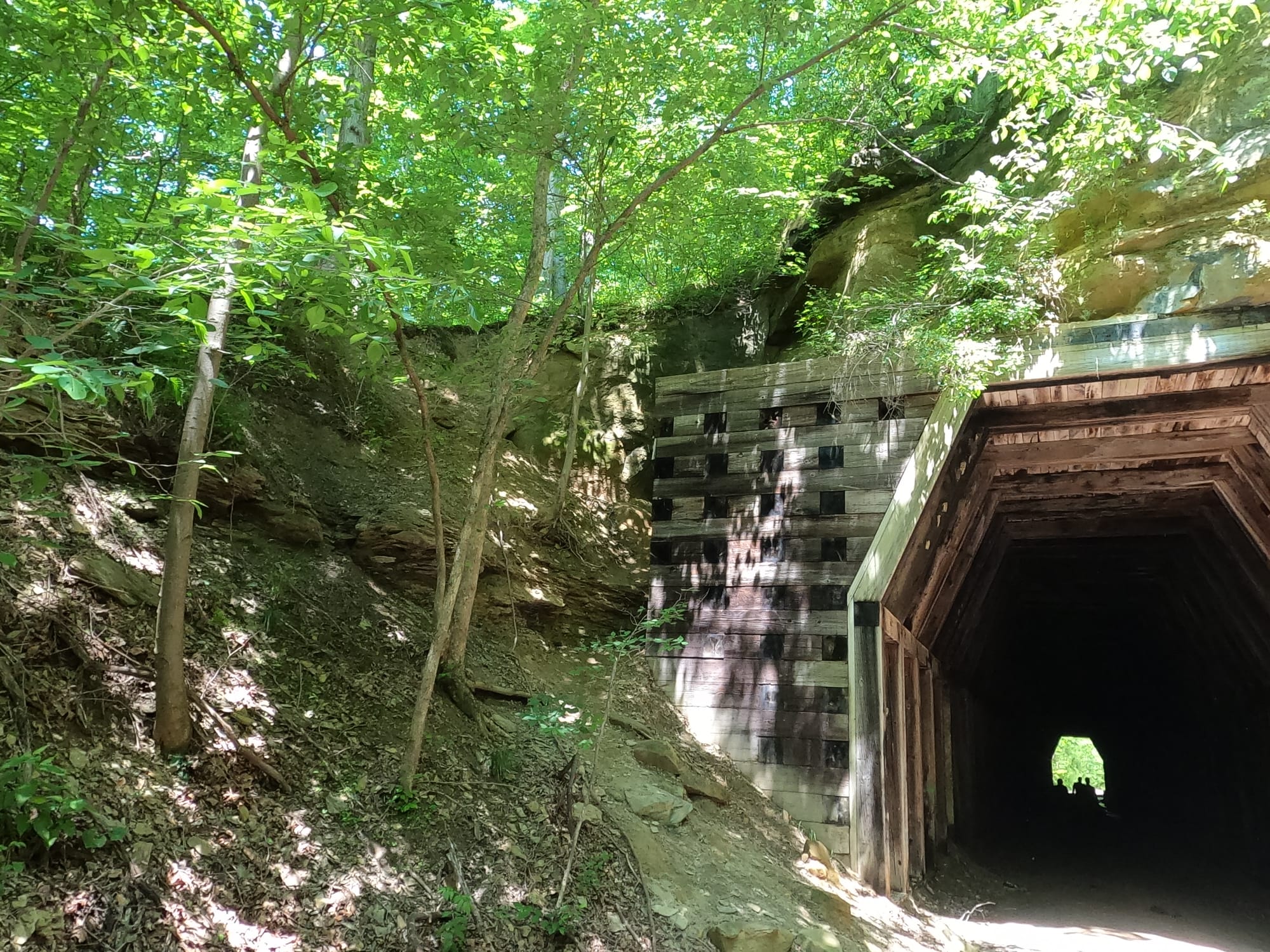
The trail climbs a small hill to the left, then the tunnel comes into view, cut through a cliff face. King's Hollow Tunnel runs about 120 feet and is lined the whole way with heavy timber framing. The interior is dark, quiet, and usually holds shallow pools of standing water on the floor. Bring a flashlight, or use your phone, both to see the timber work and to keep your footing on the wet ground. The light catches the old beams and the rough rock at the entrance in a way that's genuinely worth the short trip.
If you want a longer day, the Moonville Rail Trail runs about ten miles total and connects a string of historic sites: Zaleski, the ghost town of Mineral, and the far more famous Moonville Tunnel, the haunted centerpiece of the corridor. You can stitch King's Hollow and Moonville together into a multi-mile out-and-back if your legs are up for it.
History: a railroad town that vanished
Mineral, Moonville, and Hope were all working towns during Ohio's 19th-century iron and coal boom, strung together by the Moonville rail line that carried freight to the iron furnace at Hope. The line came through in the late 1850s when the Marietta and Cincinnati Railroad pushed into the region, and it later became part of the Baltimore and Ohio system.
King's Hollow grew out of a small stop once known as King's Station, a depot and shipping point that moved coal, timber, and iron ore out of the hills. The "King" name most likely came from a local landowning family, a common naming habit in rural Ohio at the time. As the mines played out and the iron industry declined in the early 1900s, the town shrank and was eventually abandoned. The formal "station" designation faded from the maps, and locals started calling the area by its geography instead: a hollow, in Appalachian usage, is simply a small valley between hills. Today little remains besides old rail grades, scattered foundations, the tunnel, and a lot of oral history.
The tunnel itself goes by several names, depending on who you ask: King's Hollow Tunnel, King's Switch Tunnel, the Mineral Tunnel, or just King's Tunnel. They're all the same timber-lined passage through the cliff.
The ghost stories
Like most abandoned railroad structures in southeastern Ohio, King's Hollow has collected its share of legends. Take them for what they're worth: campfire folklore, not history.
- The phantom train. On foggy nights, people claim to hear a train rumbling through the tunnel and to glimpse a faint headlamp inside, even though no tracks remain. Sound carrying through the hills from distant rail lines is the usual explanation.
- The railroad worker's spirit. A worker is said to have died during construction and to appear as a shadowy figure near the entrance. There's no verified record of a fatal accident at this exact tunnel; the story survives by word of mouth.
- The vanishing light. Teenagers have long told of a floating lantern light, flashlights flickering, and phone batteries draining near the center of the tunnel. Moisture, drafts, and cold air pockets do most of the heavy lifting here.
Why does it feel so creepy? The dense Appalachian forest, the isolation, the cold air that pools inside the tunnel, and the way the stone amplifies and distorts every sound. An abandoned tunnel in deep woods does a lot of the work on its own.
Tips and seasonal notes
- Bring a light. The tunnel is dark and the floor is often wet. A headlamp keeps your hands free.
- Wear real shoes. The rail bed is rough and can be muddy or overgrown.
- Go in fall or winter for the best atmosphere and the fewest bugs. Summer brings humidity and mosquitoes in the low, wet sections.
- Respect the site. The timbers are historic and fragile. Look, photograph, and leave it as you found it.
- Prefer to ride? Local outfitters near New Marshfield run guided horseback trips along this same corridor, including longer rides out to King's Hollow Tunnel, if you'd rather see it from the saddle.
Nearby trails
- Zaleski State Forest — the larger backpacking loop and bridle trail network surrounding the tunnel.
- Wayne National Forest — more remote southeast Ohio hiking and historic iron furnaces.
- Hocking Hills State Park — the waterfalls and gorges, less than an hour northwest.
More in
Where Did Neil Armstrong Live? His Wapakoneta, Ohio Boyhood Home
Neil Armstrong's boyhood home at 601 West Benton Street in Wapakoneta, Ohio, where he lived through high school and took flying lessons nearby.