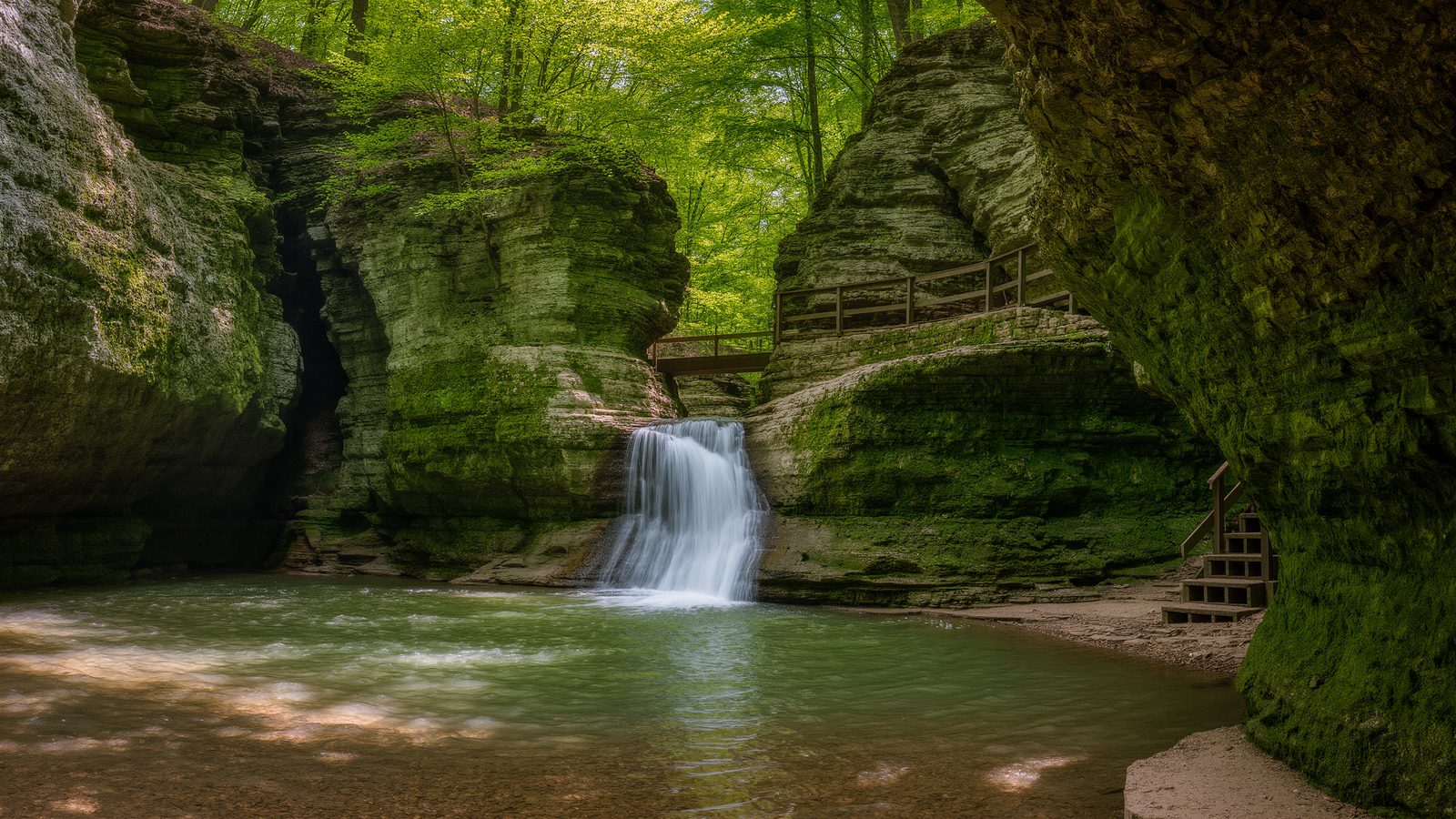
Glen Helen Nature Preserve: Yellow Springs' Gorge and Cascades
The town is named after the spring, and the spring is the color of old pennies. That's the first thing I want you to understand about Glen Helen, because it explains the whole place. Yellow Springs, Ohio got its name from a real, specific seep in the woods where iron-rich water bubbles up and stains the rock and the streambed a deep rusty orange-yellow. People have been walking to look at it for two hundred years. You can still walk to it today, and the path to get there is one of the best short hikes in southwest Ohio.
Glen Helen is a thousand acres of preserved gorge, forest, and meadow wrapped around Yellow Springs Creek and Birch Creek, with something like twenty miles of footpaths stitched through it. At the south end the trails tie into John Bryan State Park and Clifton Gorge, so the whole protected corridor runs for miles. You could spend a full day here and not repeat yourself. But most people, me included on a first visit, come for one specific loop: the walk down to the Cascades and the Yellow Spring.
It is, quietly, one of Ohio's great walks. Here's how to do it right.
Trail Stats
- Distance: the Inman Trail loop runs about 1.5 miles; longer combinations easily reach 4 miles
- Difficulty: moderate — the preserve calls every hike here moderate, and the limestone stairs are why
- Trail type: loop, with a large connected network
- Surface: dirt path, boardwalk, and limestone stone steps
- Time: 1 to 2 hours for the core loop
- Where: Yellow Springs, Greene County, southwest Ohio
- Parking: a $10 fee at the Cascades entrance lot — and worth knowing about before you arrive
Getting There
The main trailhead is the Cascades Entrance at 1075 State Route 343, Yellow Springs, on the edge of the village. This is where you'll find the parking lot, the Outdoor Education Center, and the Raptor Center, plus the most direct trail access to the Cascades and the Yellow Spring.
Here's the thing nobody tells first-timers, so I will: there's a parking fee. It runs around $10 at the Cascades lot. Glen Helen doesn't get tax money — it's a private nonprofit preserve — so that fee is genuinely keeping the lights on and the trails maintained. Bring a card or cash and don't be the person grumbling at the gate. If you'd rather skip the fee, there's a less-developed access from the north, near downtown Yellow Springs, where some trails begin just northeast of the village and you cross the creek on stepping stones. But for a first visit, park at the Cascades lot, pay the ten bucks, and start from the front door.
Yellow Springs is about an hour from Columbus and twenty-some minutes from Dayton, which makes Glen Helen a very doable day trip from either. The village itself is worth building time around — it's a walkable little arts town with good coffee and better people-watching, and you'll want a meal after the hike.
The Trail
From the Cascades entrance, the Inman Trail is the classic loop, marked on the preserve map as a red dashed line. It's about a mile and a half, and it strings together the headline sights: the waterfall over Birch Creek that everyone calls the Cascades, the Yellow Spring itself, a beaver dam, limestone cliffs, and some genuinely old trees.
The loop begins and ends with limestone stairs, and those stairs are the reason Glen Helen rates every hike as moderate. There's real elevation change between the gorge floor and the rim, and the steps cover it in a hurry. They're solid and well-built, but they're stone, so they're slick when wet and they'll get your heart going on the climb out. If you've got knees that complain about stairs, here's the workaround the preserve actually recommends: instead of plunging straight down the Inman steps, head north on the Talus Trail first, then switch back and cross the Old Dam Bridge to start the Inman loop from a gentler grade. Same sights, kinder on the joints.
Down on the gorge floor, the walk turns magic. The trail runs along Birch Creek through a deep, shaded ravine. You'll pass Pompey's Pillar, a freestanding rock formation, and reach the bridge over the Cascades — a stepped series of small waterfalls tumbling over the rock. Glen Helen Falls, the ten-foot drop also known simply as the Cascades, is the showpiece, and after a good rain it runs full and loud. There's a boardwalk threading the wettest stretches, keeping you up out of the mud and over the sensitive ground.
Then the Yellow Spring. After everything else, it's almost understated — a steady seep where the iron-laden water rises and runs over rock it has dyed a deep ochre-orange over countless years. It's not dramatic the way the waterfall is. It's older than dramatic. This is the thing the town walked out to see in the 1800s, the namesake, and standing over it you get a small, real sense of continuity with everyone who's stood there before you.
If you've got more time and more legs, the network opens up from here. The Grotto, reached by way of the Oak Triangle, School Forest, and Birch trails, makes a roughly four-mile loop that takes you past more waterfalls, through a planted pine forest, and across more boardwalk. The pine forest is worth the detour just for the smell and the hush — it's a different world from the hardwood gorge, dim and needle-floored and quiet.
History and Nature
Glen Helen has been a protected, studied landscape for a long time, and it shows in how intact it is. The preserve is owned and run as a nonprofit, tied historically to Antioch College in Yellow Springs, and it's served for decades as an outdoor classroom — generations of kids have had their first real woods experience on these trails. The Outdoor Education Center and the Raptor Center, which rehabilitates injured birds of prey, are both part of that mission. If the Raptor Center is open when you visit, it's a good stop, especially with kids.
The natural draw is the gorge itself. Glen Helen sits in the same limestone-and-dolomite country as neighboring Clifton Gorge and John Bryan State Park, where glacial meltwater carved deep, steep-walled ravines into the bedrock. The result is a cool, moist microclimate on the gorge floor that supports plants more typical of places much farther north. You'll see limestone cliffs and overhangs, rock formations, and — the part that stops me every time — trees that have been standing for centuries. Some of the oaks here are pushing four hundred years old, which means they were alive before this was Ohio, before it was a state, before most of the history we learned in school.
Spring is a wildflower riot on the gorge floor; the rich, moist soil and the protection of the ravine walls make for one of the better wildflower walks in the region. There's a beaver dam on the loop, and beaver mean a working, wet ecosystem. Birds are everywhere, and the variety of habitat — gorge, creek, pine plantation, meadow, old hardwoods — packs a long species list into a compact area.
It's worth understanding that Glen Helen doesn't sit alone. It's the centerpiece of a much larger block of protected land — well over a square mile of continuous preserve when you count its neighbors. To the south the trails run straight into John Bryan State Park, and just beyond that lies Clifton Gorge State Nature Preserve, where the Little Miami River has cut a dramatic, narrow chasm through the dolomite. The three properties together form one of the most significant protected natural corridors in southwest Ohio, which is why the biodiversity here is so rich: animals and plants have room to move through an unbroken stretch of gorge and forest instead of being marooned on an island of trees surrounded by farmland. For a strong hiker, that connectivity means you can start at the Glen Helen Cascades and walk south for miles without leaving protected ground.
One honest note on timing the natural beauty: this is a leaves-on park. A regular here put it well — come when the trees are green, late spring through early fall. Winter has its own bare-bones appeal, but Glen Helen is built to be seen in full leaf, with the gorge walls dripping and the canopy closed overhead.
Why the Spring Is Yellow
People ask, so here's the short geology lesson, and it's a good one to have in your back pocket when you're standing over the spring with kids. The groundwater here percolates down through iron-bearing rock, picking up dissolved iron along the way. When that water surfaces at the spring and hits the air, the iron oxidizes — it rusts, basically, the same chemistry as a wet nail left out overnight. The rust precipitates out and coats the streambed and the surrounding rock in that distinctive ochre orange-yellow. So the "yellow" you're looking at is iron oxide, laid down grain by grain over an enormous span of time. The town didn't get a fanciful name; it got an accurate one.
It's worth pointing out to a kid because it's one of those rare cases where you can see a slow chemical process frozen in place. The water is still doing it, right now, the whole time you're standing there. In the 1800s the spring was a genuine destination — there were resort hotels in Yellow Springs built around the idea that the mineral water was good for you. The medicinal claims didn't hold up, but the spring outlasted the hotels, and people are still making the walk.
Pompey's Pillar, which you pass on the way, is another stop-and-look feature: a tall, freestanding column of rock left standing as the softer stone around it eroded away. From the Oak Triangle Trail up on the rim, there are overlooks down onto the Pillar and the boardwalk threading the gorge below — a good spot to stop, catch your breath after the stairs, and take in how deep the ravine really is.
Tips and Seasonal Notes
Wear real shoes. Those limestone stairs and the wet gorge-floor rock are no place for flip-flops. Trail shoes or boots with grip, every season. After rain, assume everything stone is slick.
Go early or go midweek. Glen Helen is popular, deservedly, and the Cascades lot fills on nice weekends. An early start gets you the gorge in morning light and a parking spot without circling.
Budget the fee. Around $10 to park at the Cascades lot. It's not a tourist gouge — it's how a nonprofit preserve with no tax base keeps twenty miles of trail open. Pay it gladly.
Time it for water. The Cascades run hardest after rain and in spring snowmelt. In a dry late summer they slow to a trickle. If the waterfall is your main goal, check the recent weather and go after a wet stretch.
Make a day of it. Glen Helen connects to John Bryan State Park and Clifton Gorge to the south, so ambitious hikers can chain them into a long day. And the village of Yellow Springs is right there for food afterward.
Hiking with kids? The core Inman loop is short enough for elementary-aged kids, and there's enough to look at — a waterfall, a colored spring, a beaver dam, old giant trees — to keep them moving. Just respect those limestone stairs with little ones, hold hands on the wet steps, and consider the gentler Talus Trail approach if you're carrying a toddler. If the Raptor Center is open, time your loop to end there; a face-to-face with a rehabbing owl or hawk is the kind of thing that turns a hike into a memory.
Nearby Trails
Glen Helen is the heart of a cluster of great southwest-Ohio hikes:
- John Bryan State Park shares a border at the south end and continues the gorge along the Little Miami — the natural second half of a Glen Helen day.
- For more waterfall hiking around the state, my Ohio waterfall hikes roundup maps out where to chase cascades season by season.
- Planning a Dayton-area outing? The best hikes near Dayton guide puts Glen Helen in context with the rest of the region's trails.
I've hiked a lot of Ohio, and Glen Helen still lands near the top. A spring-colored spring, a real waterfall, four-hundred-year-old trees, and a gorge that feels like it was carved for walking. Pay the ten dollars, take the stairs, and go see the thing the town was named for.
🥾
More in
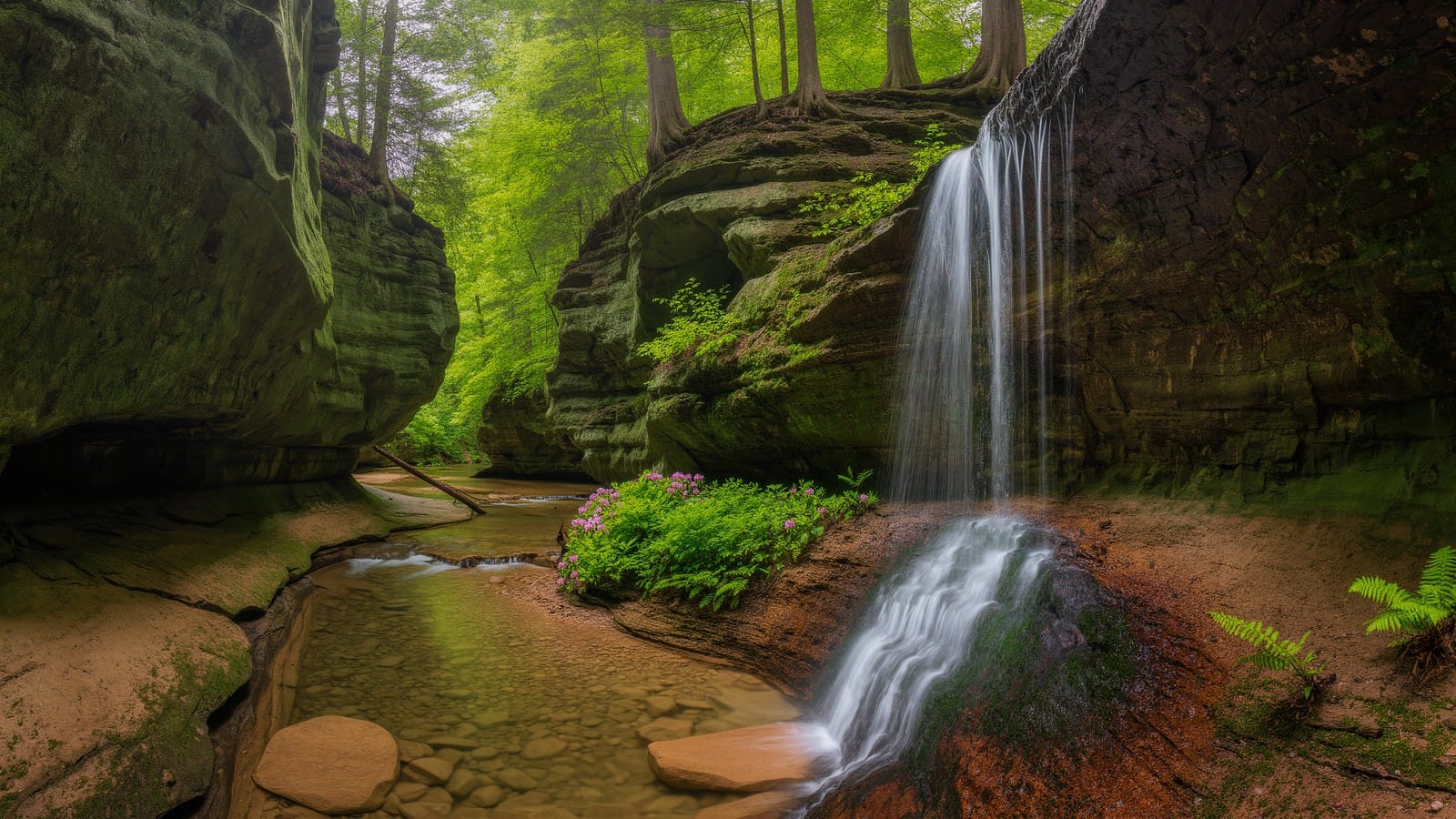
Lake Katharine State Nature Preserve: Hidden Gorges and Rare Magnolias
Lake Katharine State Nature Preserve in Jackson County hides two sandstone gorges, cool hemlock ravines, small waterfalls, and Ohio's rare bigleaf magnolias.
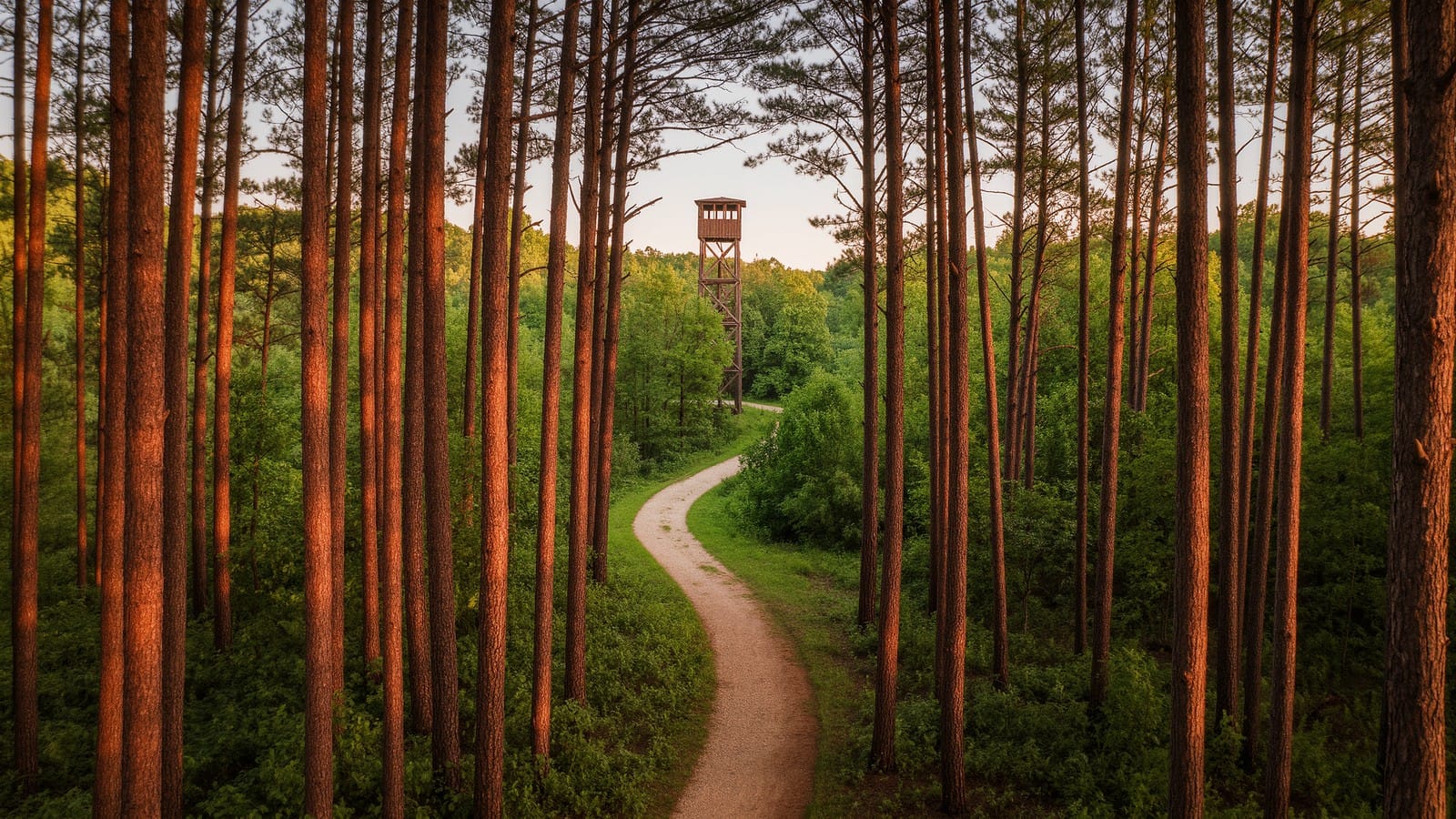
Tar Hollow State Park: Fire Tower Views and Remote Ridge Trails
Tar Hollow State Park is one of Ohio's most remote hikes: a climbable fire tower, the 15-mile Logan Trail, and miles of quiet ridge-and-hollow forest.
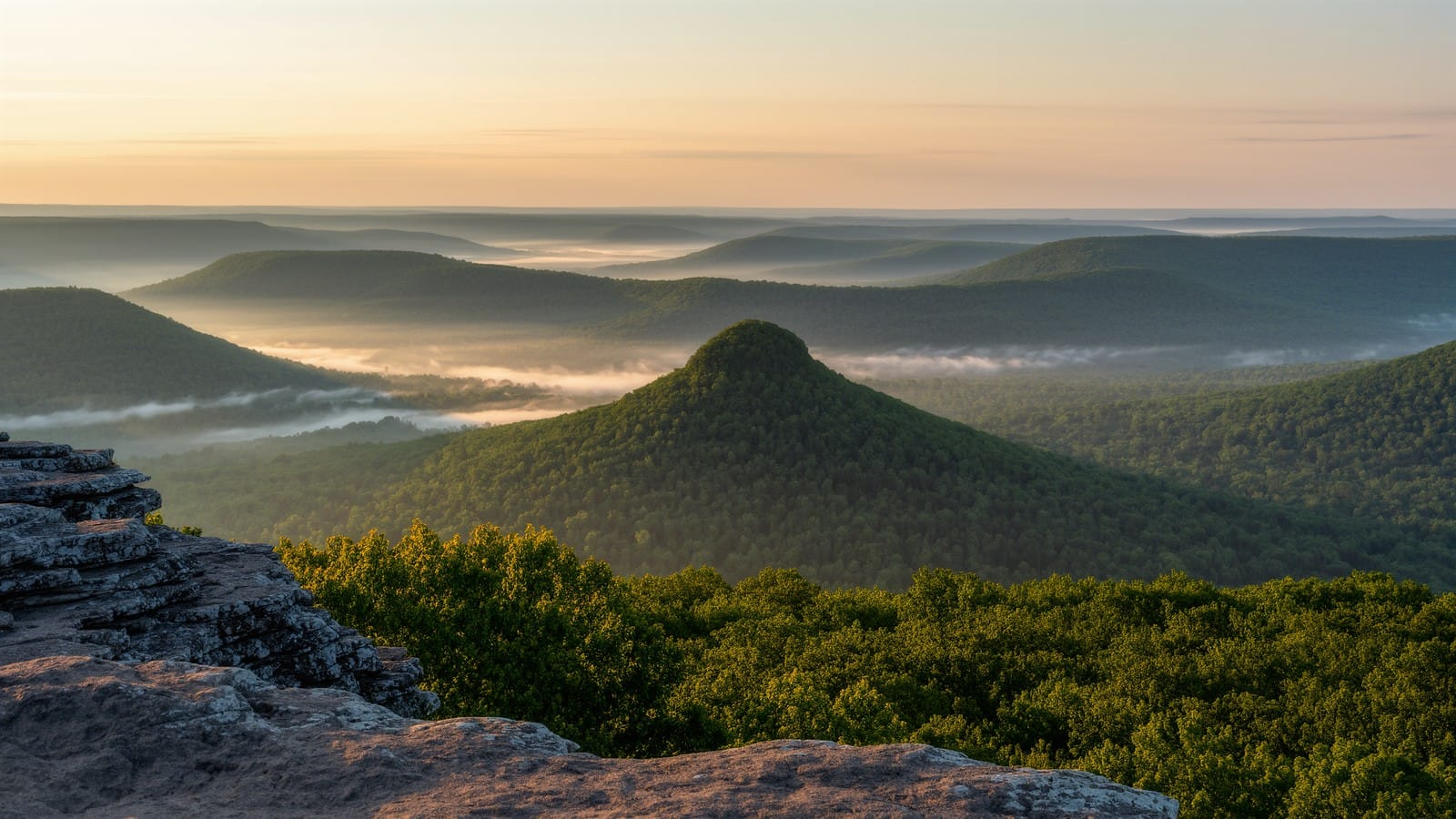
Great Seal State Park: The Rugged Hills That Inspired the Ohio State Seal
Great Seal State Park near Chillicothe hides Ohio's most rugged ridge hiking. Climb Sugarloaf Mountain to the view that inspired the state seal.