Lake Hope State Park: Iron Furnace Ruins and Deep Forest
Deep in Vinton County, in the least-populated corner of Ohio, there is a lake ringed by forest so thick and quiet it feels like the edge of the map. No towns crowd it. No highway runs along it. The loudest thing most afternoons is a woodpecker working a dead snag. And standing above the water, on a slope of trees, is the tall stone stack of an old iron furnace that has not made iron in 150 years — a ruin from a vanished industry, slowly being reclaimed by the woods that industry once destroyed. Lake Hope is one of the most remote and atmospheric state parks in Ohio, and it is worth every mile of the drive to get there.
Lake Hope State Park covers 2,983 acres tucked entirely inside Zaleski State Forest, about five miles northeast of the village of Zaleski (ODNR as of September 2026). It is a place with layers: a 120-acre lake, a ghost town, an old cemetery, a famous iron furnace, and a trail network that ranges from gentle lakeside strolls to serious backcountry mileage. If you want to feel like you have actually gotten away — genuinely away, out where the dark skies come out at night — this is one of the best places in the state to do it.
Visitor info (as of September 2026): 27331 State Route 278, McArthur, OH 45651. Park office (740) 596-4938 (often listed 9 a.m.–5 p.m.; extended peak weekends). Park hours 6 a.m.–11 p.m. daily (legitimate recreation may continue outside those hours — call to confirm). Admission free. Nature center (740) 596-3030 (hours vary). Confirm on the ODNR Lake Hope page (property HTML intermittently 404’d from this runner).
Trail at a Glance — Lake Hope State Park
- Distance: A range of options, from short lakeside loops (ODNR lists segments ~0.25–3.2 mi) to the ~29-mile Zaleski backpack loop nearby
- Difficulty: Easy to hard — mellow lake trails, steep forested ridges deeper in
- Best season: Fall for legendary color; spring for wildflowers and flow
- Dogs: Leashed dogs welcome on trails
- Highlights: Hope Furnace ruins, Lake Hope, deep forest, a ghost town, dark skies
- Location: Near Zaleski, Vinton County, Ohio, inside Zaleski State Forest
Getting there and where to start
Lake Hope is remote by Ohio standards, and that is a feature, not a bug. It sits in the hills of Vinton County, roughly an hour and a half southeast of Columbus and about the same from the Hocking Hills. The drive in takes you down winding forest roads through Zaleski, and cell service gets thin, so download your map before you lose signal. Admission, like all Ohio state parks, is free.
The natural hub is the area around the lodge and the Hope Furnace. The park's dining lodge — rebuilt after a fire years back — sits above the lake, and the furnace ruins are right nearby off State Route 278. Park in that zone and you are within easy reach of the lake trails, the furnace, and the old cemetery. Grab a map from the park office or the lodge, because the trails here braid together with the much bigger Zaleski forest network, and it is easy to wander farther than you meant to.
The trails
Lake Hope gives you a real range, which is part of what makes it such a good all-day park. ODNR trail listings (as of September 2026) include Buzzard Cave and Greenbriar (~0.5 mi moderate each), Peninsula (~3 mi moderate), Furnace (~3.2 mi moderate, multi-use), White Oak (~0.25 mi), Habron Hollow and Olds Hollow (~1.5 mi each), and Tulip (~1 mi). Down by the water, short and gentle loops trace the lakeshore and the wooded coves — easy walking, good for families, with herons and turtles and the occasional splash of a jumping fish. These are the trails to start on if you just want to stretch your legs and take in the water.
Push deeper and the terrain gets serious. The forested ridges around the lake climb and drop steeply, and the trails that wind up into Zaleski State Forest turn into genuine hill work. The marquee backcountry route in the area is the Selinde Roosenburg Memorial Backpack Trail in Zaleski, a rugged loop of about 28.8–29 miles (ODNR; older posts often said ~23) — one of Ohio's best-known overnight backpacking trips, with walk-in camps and mining-era remnants along the way. It starts near the village of Zaleski, and it is a real undertaking; I have written about the Zaleski forest separately, and it deserves its own trip.
There is also a well-regarded mountain bike trail here — a long singletrack loop that has been rated among the best in Ohio. Even if you are on foot, it is worth knowing the bikes are out there so you can share the trail politely. Between the easy lake loops, the steep forest ridges, the backpack route, and the bike singletrack, Lake Hope rewards whatever kind of day you show up wanting.
Hope Furnace and the iron that built Ohio
The stone tower above the lake is the reason this whole landscape looks the way it does. Hope Furnace was built in the 1850s and ran for about two decades, one of dozens of iron furnaces that once roared across southeastern Ohio in what was called the Hanging Rock Iron Region. This was heavy industry, deep in the hills, long before anyone thought of the area as a place to hike.
The furnaces ran on charcoal, and charcoal comes from wood — enormous quantities of it. To feed a single furnace, crews clearcut the surrounding forest, hauling in timber to be burned down into fuel. Multiply that by dozens of furnaces running for years, and you get the result: the hills of Vinton County were stripped nearly bare. The iron industry ate the forest around it, and when the ore and the easy timber ran out, the furnaces went cold and the companies left, and the land was abandoned raw and eroded.
That devastation is exactly why the park exists. By the 1920s, people were alarmed enough about the deforestation that the state stepped in — the Ohio forestry program bought up the ruined land starting in 1928, and it became Zaleski State Forest. The trees came back. The furnace stayed, a stone ghost of the industry that had leveled the very woods now growing up around it. Standing at the base of that cold stack, looking up at second-growth forest that has completely reclaimed the hillside, is one of the more quietly powerful history lessons you can get on an Ohio trail.
A ghost town, a cemetery, and the woods taking it all back
The iron industry did not just leave a furnace. It left people, and the traces of the lives they lived out here.
There was a company town called Hope, built to house the furnace workers and their families, and today it is a ghost town — foundations and hints in the forest rather than standing buildings. Along the trails you can still find an old cemetery, the graves of the furnace-era families who lived and died in these hills when this was an industrial frontier, not a park. Walk the ground near the furnace and you are walking through the outline of a vanished community.
I find this the most haunting part of Lake Hope, more than the lake or the color. A whole town lived here, worked brutal jobs feeding a furnace, buried their dead on a hillside, and then vanished when the industry moved on. The forest simply grew back over the top of all of it. The trees you are hiking through are younger than the graves. That is a strange and moving thing to hold in your head as you walk, and it is the kind of layered history that Ohio's southeastern hills do better than anywhere else in the state.
Deep forest, dark skies, and legendary fall color
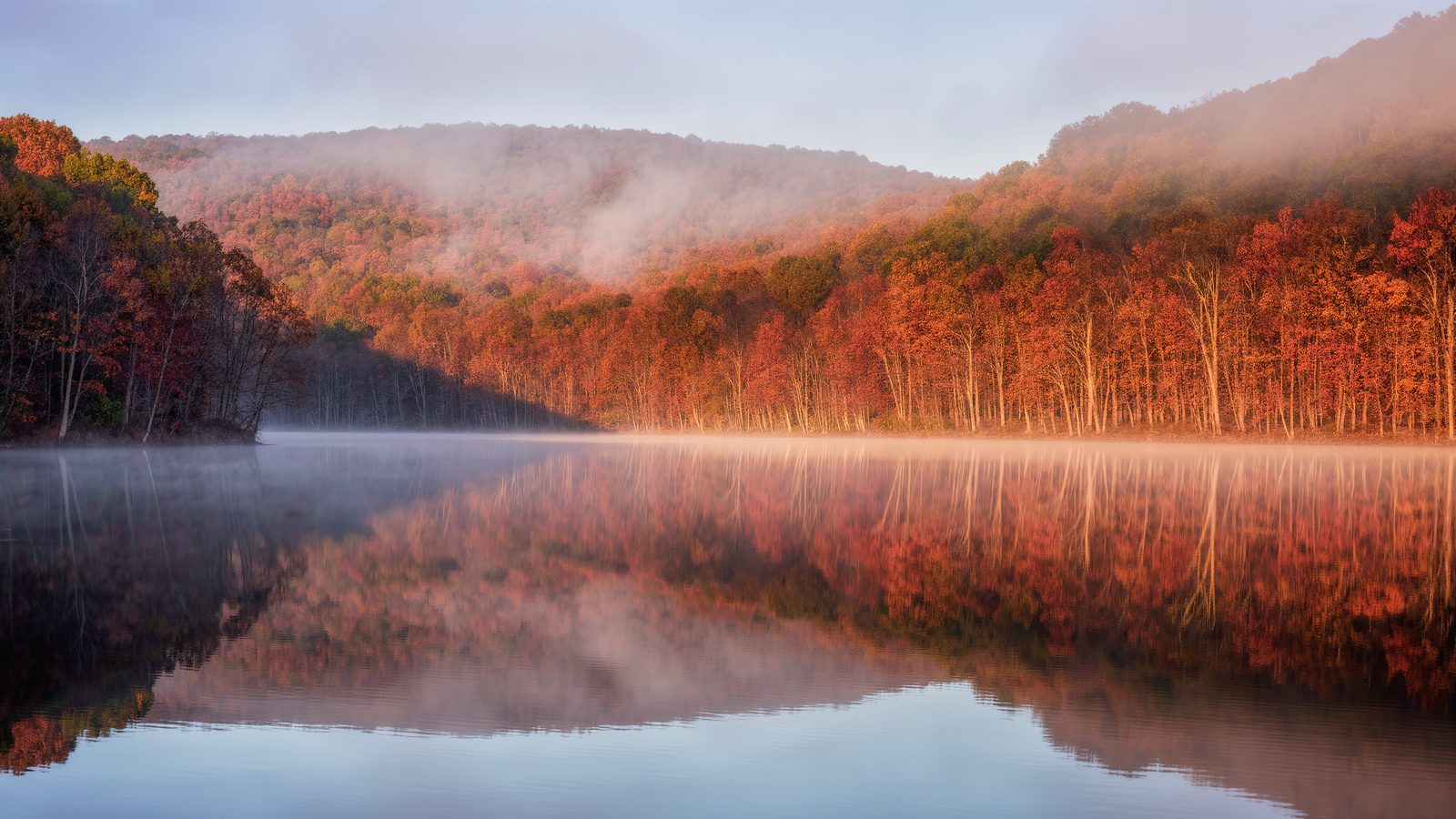
Set the history aside and Lake Hope is still one of the prettiest parks in Ohio, especially in autumn. The mixed hardwood forest that reclaimed these hills puts on a spectacular fall show — deep reds and golds rolling across ridge after ridge, mirrored in the still lake. People drive down from Columbus every October just for the color, and the remoteness means it never feels as mobbed as the Hocking Hills a little to the north.
Because it is so far from any city, Lake Hope also has genuinely dark night skies. Camp here or stay at the lodge and, on a clear night, you get a sky full of stars that most Ohioans never see from home. The lack of light pollution out in Vinton County is a real rarity for this state, and it turns an ordinary campsite into a front-row seat for the Milky Way. The forest is full of wildlife too — white-tailed deer everywhere, wild turkey, plenty of songbirds and woodpeckers, and the general sense of a big, wild, lightly-traveled woods that you simply do not get in the metro parks up north. Move quietly on an early-morning trail and you will see more of it than you expect.
How I would spend a day here
If you have never been and you want a plan, here is the one I would hand you — and because it is a long drive, I would build it into a full day rather than a quick lap. Get an early start out of Columbus or the Hocking Hills so you are pulling onto the forest roads by mid-morning. Make your first stop the Hope Furnace. Walk around the base of the stack, read the markers, and take a few minutes to let the scale of it land — a 150-year-old industrial ruin standing quiet in second-growth woods.
From there, do one of the gentler lakeside loops while the day is still cool, keeping an eye out for herons in the shallows and turtles logging on the deadfall. If you brought hearty legs and daylight, climb one of the forest trails up onto a ridge for the longer views over the trees; even a couple of miles up and back gives you the deep-woods feel that the lake trails alone do not. Somewhere in there, walk over to the old cemetery and spend a quiet few minutes with the furnace-era graves. It is the kind of stop that changes the whole tone of the hike.
Break for lunch at the lodge above the lake if it is open, then finish the afternoon however you like — a paddle on the calm water, a longer trail, or just a slow walk back along the shore. If you can swing it, do not drive home at dark. Stay for the night and let those famously dark Vinton County skies do the last part of the show.
Tips and seasonal notes
- Come in the fall. October color at Lake Hope is the stuff of legend, and the remote setting keeps the crowds thinner than the more famous parks. It is the single best time to visit.
- Download your map before you arrive. Cell service is spotty out in Vinton County. Have your route and directions saved offline before you lose signal.
- Know how far you are going. The lake trails are gentle, but they connect to steep forest ridges and the long Zaleski loop. Match your route to your legs and your daylight.
- Stay the night if you can. With a campground, cabins, and the lodge on site — plus those dark skies — Lake Hope rewards an overnight far more than a rushed day trip.
- Respect the history. The furnace, the cemetery, and the ghost-town traces are irreplaceable. Look, photograph, and leave everything exactly where it stands.
Why it is worth the drive
Lake Hope asks more of you than most Ohio parks — it is farther, more remote, harder to get to. What it gives back is worth it: a quiet lake ringed by deep forest, a 150-year-old iron furnace standing over the water, a ghost town and a cemetery swallowed by the woods, some of the darkest skies in the state, and fall color that rivals anywhere in Ohio. It is a park that tells you a whole story about how these hills were used, ruined, and healed, and you read that story with your boots.
I have driven the long forest road into Lake Hope more than once wondering if it was worth it, and every single time the answer was yes the moment the lake came into view with that stone stack above it. That is the Lake Hope effect. Save your map offline, aim for October if you can, plan to stay the night, and go see the wild, haunted, beautiful far corner of Ohio.
🥾
Nearby trails to explore
- Zaleski State Forest: the ~29-mile Selinde Roosenburg backpack loop surrounding the park
- King's Hollow Tunnel: a ghost-town rail tunnel in Zaleski
- Hocking Hills State Park: Every Trail Ranked: the famous gorges to the north
- Clear Creek Metro Park: a long hemlock gorge near Lancaster
- Best Fall Hikes in Ohio: ten trails for peak foliage
More in

Shawnee State Park: Ohio's Little Smokies Hiking Guide
Shawnee State Park near Portsmouth, Ohio's Little Smokies: Appalachian ridge hikes, two swimming lakes, and the toughest backpacking trail in the state.
Hueston Woods State Park: Old-Growth & Fossil Trail Guide
Hueston Woods State Park near Oxford: old-growth forest, 450-million-year-old fossils you can keep, Acton Lake, and 40-plus miles of trails. Full guide.