Leo Petroglyph and Nature Preserve: Ancient Carvings and a Gorge
There's a face carved into the sandstone with deer antlers growing out of its head and a bird's feet where a chin should be. Nobody alive knows for certain what it meant. Somebody cut it into the rock here in southern Ohio somewhere between seven hundred and a thousand years ago, and it's still here, under a simple wooden shelter at the edge of a gorge in Jackson County, waiting for you to come stand in front of it.
That's the strange and wonderful thing about Leo Petroglyph & Nature Preserve. It's tiny — under thirteen acres — and it's out in the rural hill country an hour and a half south of Columbus, on a winding road past a handful of houses and a pretty little country church. There's no visitor center, no entrance fee, no crowds. Just thirty-seven ancient carvings on a slab of bedrock, and a short, rocky, genuinely beautiful trail dropping into a hemlock gorge below them. It is one of the best history-and-hiking combinations in the state, and almost nobody outside the area has heard of it.
I'll tell you what's there, how to walk it, and why it's worth the drive.
Trail Stats
- Distance: about 0.7 mile nature trail loop
- Difficulty: short but moderate — rocky footing, stairs, and elevation change in the gorge
- Trail type: loop, starting at the petroglyph shelter
- Surface: dirt, rock, and stone steps; uneven throughout
- Time: allow an hour or more to see the carvings and walk the gorge
- Where: near the village of Leo, Jackson County, southern Ohio
- Cost: free; grounds open year-round
Getting There
Leo Petroglyph is in deep southern Ohio, near the tiny community of Leo, northwest of the city of Jackson. From Columbus it's roughly an hour and a half south, dropping out of the flat glaciated farmland into the unglaciated Appalachian foothills — which is exactly why the landscape down here looks so different, more rugged and rocky than central Ohio.
A word of real caution on the approach: the petroglyph sits right on Park Road, a narrow, winding country lane, and some locals drive it fast. The site is tucked in right before a cluster of homes, so go slow, watch the curves, and be respectful of the folks who live there — this isn't a developed park with a buffer, it's a historic site sitting in someone's neighborhood. There's a photo-worthy old church, Trinity Methodist Episcopal, right on the road if you want a stop.
The site is managed by the Ohio History Connection and cared for locally by the Friends of Buckeye Furnace in cooperation with the Jackson County Historical Society. The grounds are open year-round and free. Facilities are minimal, so come prepared and self-sufficient.
The Carvings
Start at the shelter. The petroglyph is a single large slab of Black Hand sandstone, roughly twenty feet by sixteen, carved with thirty-seven figurative images, and it's protected from the weather by a wooden shelter that was itself built as a Works Progress Administration project back in the 1930s. So there's history layered on history here — Depression-era hands built the roof that protects carvings made centuries before Columbus sailed.
Take your time reading the rock. The thirty-seven figures include humans, birds, a fish, a snake, animal and human footprints, and assorted symbols whose meanings are lost to us. The famous one — the image that makes the postcards — is that human head wearing deer antlers with a bird's feet, a figure that clearly meant something specific and powerful to whoever carved it, and that we can now only guess at. Shamanic? Mythological? A clan marker? The honest answer is that we don't know, and that uncertainty is part of standing there. You're looking at a message you can see but cannot read.
The carvings are almost certainly the work of the Fort Ancient culture, the late prehistoric people who lived across southern Ohio from roughly 1000 to 1650 AD. Archaeologists date the petroglyphs by the weathering of the soft sandstone, which puts them somewhere around seven hundred to a thousand years old. The slab was added to the National Register of Historic Places in 1970. It originally sat exposed on the edge of the sandstone hillside above the gorge; to protect it, the rock was carefully covered with the shelter you see today, which is why it has survived legible for so long when so much Ohio rock art has weathered away to nothing.
The Trail
Behind the shelter, a short nature trail drops off the ridge and descends into the gorge below the carvings. Don't skip it. People come for the petroglyph and leave thinking the hike is an afterthought; it's actually a small gem in its own right.
The trail is under a mile, but it earns its moderate rating. The footing is rocky and uneven, there are a lot of stairs, and the elevation changes come fast as you drop into and climb out of the ravine. This is not a stroller trail. It is, however, completely doable for elementary-aged kids and up who are steady on their feet — just keep them close on the rock and the stairs.
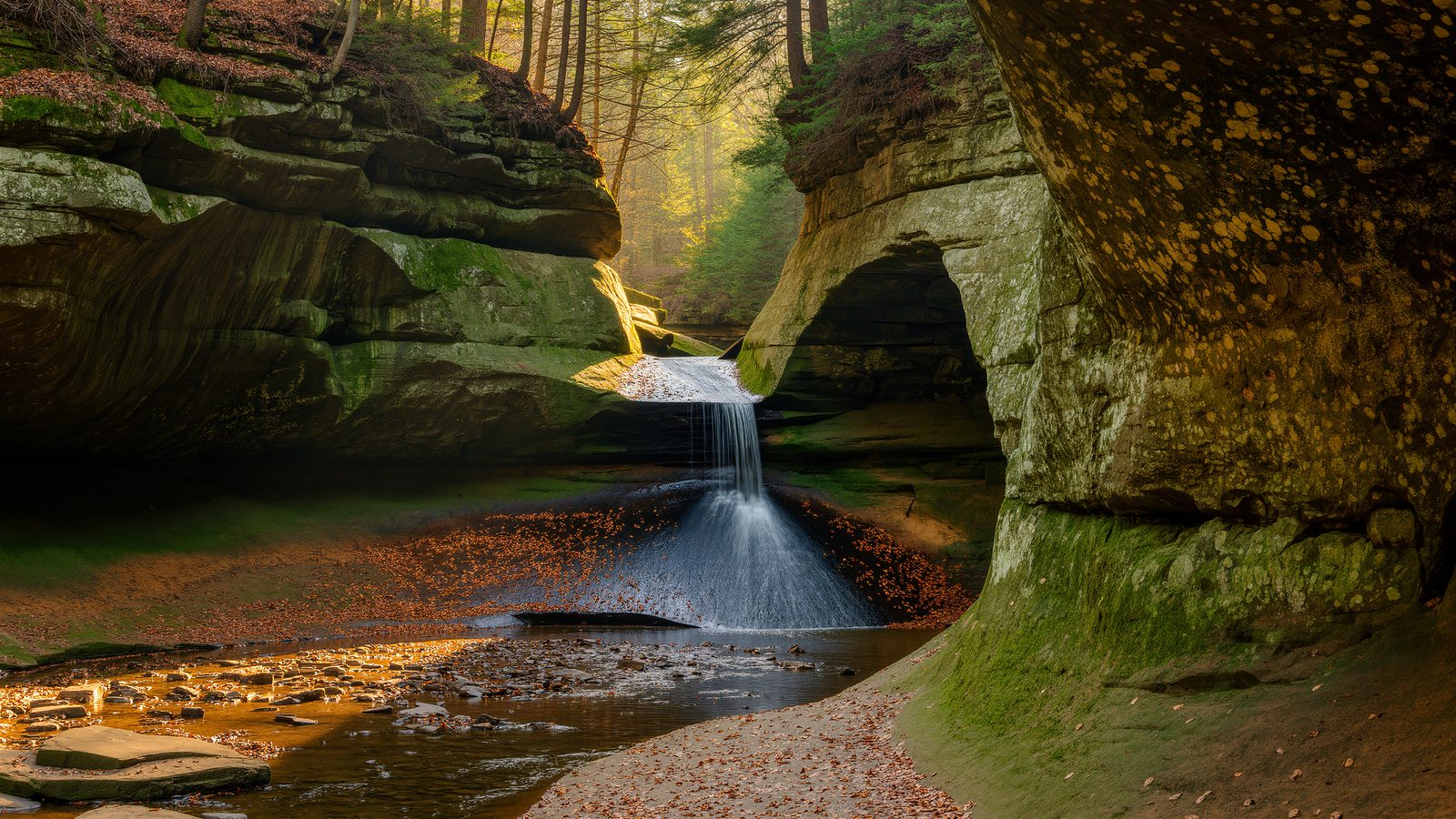
What you get for that effort is a genuine little Appalachian gorge. The trail winds along intermittent cliff walls of that same Black Hand sandstone, with the unglaciated Mississippian cliffs rising twenty to sixty-five feet over your head in places. There are bedrock overhangs and rock shelters — the kind of dry, sheltered recesses that almost certainly sheltered people thousands of years ago, long before anyone carved the slab up top. Within the gorge are several small waterfalls, seasonal and best after rain, threading down over the rock. The east bank is dominated by Eastern hemlock, those dark evergreen conifers that hold the cool, shaded microclimate of the ravine and give the whole gorge a hushed, northern feel even in a southern Ohio summer.
In season, wildflowers and birds are abundant down here. The combination — ancient art on the rim, a hemlock gorge with waterfalls and overhangs below — is what makes Leo punch so far above its thirteen acres. There's a tip in the visitor lore I like: come in the rain. On a wet day you'll likely have the place entirely to yourself, and you'll get to watch the water drain over the rock overhangs and run down into the gorge, which is the landscape doing the exact thing that carved it.
History and Nature
It helps to zoom out on who made these carvings. The Fort Ancient people were farmers and villagers — they grew corn, beans, and squash, built substantial settlements along the rivers of southern Ohio, and lived here for centuries before European contact and the disruptions that followed. They were not the same as the earlier Hopewell and Adena moundbuilders, though they shared the same landscape. The petroglyphs at Leo are one of the relatively few places where you can stand in front of something these specific people made with their own hands, on the actual rock, in the actual place they chose. Most of what we know about them comes from village sites and excavated objects in museums. Here, the art is still on the cliff.
The geology that made the carving possible is the same geology that makes the hike. Black Hand sandstone is a soft, workable stone — soft enough to carve with stone tools, soft enough to erode into cliffs, overhangs, and rock shelters. The whole gorge is a master class in how this rock behaves: water and time cut down through it, leaving the hard ledges standing as cliffs and undercutting the softer layers into the shelters that drew people in the first place. The hemlocks on the cool east bank are a living signature of that shaded, moist gorge environment — they're a more northern tree hanging on in a southern county precisely because the ravine stays cool.
It's the same Black Hand sandstone, by the way, that forms the famous formations up in Hocking Hills — Old Man's Cave, Ash Cave, the whole gorge system that draws millions of visitors a couple of hours north. Leo is carved from the identical rock, just without the crowds and with something Hocking Hills doesn't have: a thousand-year-old gallery of human art on the rim. If you've hiked the Hocking Hills recess caves and wondered who used them before they were state parks, Leo is a place where part of that answer is literally written on the stone.
Why It's Worth the Drive
Let me be straight about the math, because Leo is a long way from anywhere and I don't want you to feel cheated. The carvings themselves take fifteen minutes to really look at. The trail is under a mile. On paper, that's a thin payoff for a three-hour round trip from Columbus.
But that math misses what actually makes Leo special, which is the rarity of the experience. There are not many places in the eastern United States where you can stand on the original rock and look at art that prehistoric people carved there, in the open, for free, with nobody else around. Most rock art is on private land, or destroyed, or roped off behind glass in a museum, severed from the place that gave it meaning. At Leo the slab is right where it has effectively always been, under a humble shelter, in the landscape the carvers knew. You walk down into the same gorge they sheltered in. You see the same hemlocks, the same overhangs, the same seasonal water. That continuity is the whole point, and it's not something you can get from a photo or a museum case. Pair it with Buckeye Furnace down the road, give the gorge trail its due, and the drive earns itself.
Tips and Seasonal Notes
Make it a day with Buckeye Furnace. This is the move. Buckeye Furnace, a restored 19th-century charcoal-iron furnace and another Ohio History Connection site, is about thirty minutes away near Wellston. The grounds are open year-round; the museum and gift shop run roughly May through October. Pairing the ancient rock art at Leo with the industrial-history furnace makes a full, varied day in Jackson County.
Mind the road and the neighbors. Park Road is narrow and winding, traffic moves fast, and the site abuts private homes. Drive carefully and tread respectfully.
Wear real shoes. The gorge trail is rocky, stepped, and uneven. Trail shoes or boots with grip, and watch your footing on wet rock.
Rain is a feature, not a bug. A wet visit means solitude and running water over the overhangs. Just take the slick rock seriously.
Self-sufficient visit. Minimal facilities, no concessions. Bring water, bring snacks, and pack out your trash. Cell service can be spotty out here.
Be a steward. Never touch or chalk the carvings, and don't climb on the slab. This is irreplaceable, fragile, centuries-old rock art on the National Register. Look all you want; keep your hands off — the oils on human hands and the abrasion of fingers tracing the grooves are exactly what wears soft sandstone carvings away over time. Photograph them instead, and leave them as you found them for the next person and the next century.
Bring a small flashlight. The shelter is roofed, and on an overcast day or in low light the shallow carvings can be hard to read. Raking light from the side — a flashlight held low and angled across the slab — throws the grooves into relief and makes the figures pop. It's the single best trick for actually seeing all thirty-seven.
Nearby Trails
Leo Petroglyph anchors a southern-Ohio history-and-hiking circuit:
- For more deep-southern-Ohio hill country, Zaleski State Forest and the King's Hollow Tunnel ghost-town hike are within reach to the east.
- Chasing Ohio's history through its trails? Wayne National Forest runs the same Appalachian foothills with its own iron-furnace heritage.
- For more rock and gorge scenery, the Hocking Hills every-trail roundup covers the famous Black Hand sandstone country to the north.
Thirty-seven figures, seven hundred years, a hemlock gorge, and a road most people will never turn down. Leo Petroglyph is small, it's out of the way, and it's one of the most quietly extraordinary places I've stood in Ohio. Go slow, look long, and keep your hands in your pockets.
🥾
More in
Lake Katharine State Nature Preserve: Hidden Gorges and Rare Magnolias
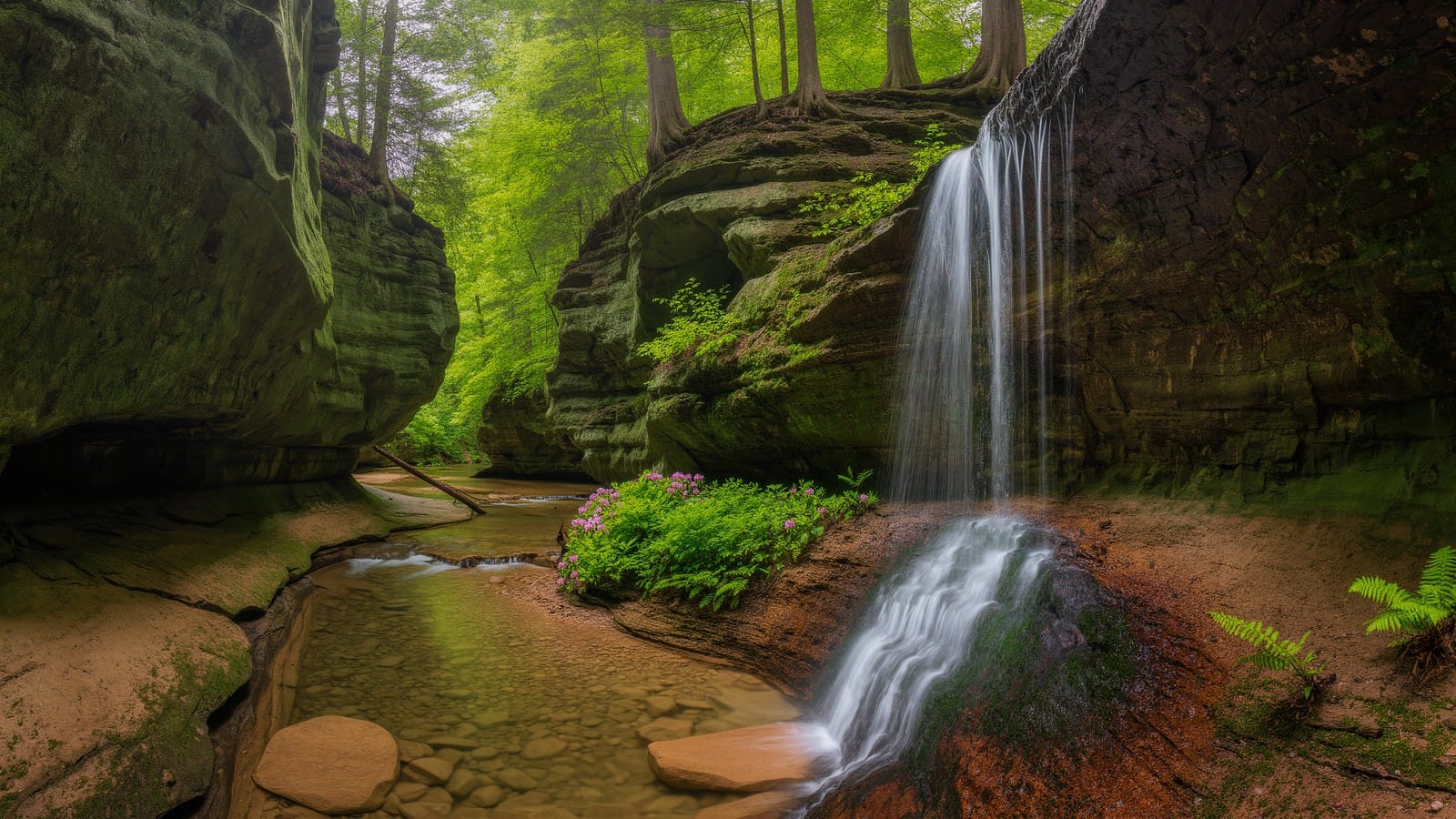
Lake Katharine State Nature Preserve in Jackson County hides two sandstone gorges, cool hemlock ravines, small waterfalls, and Ohio's rare bigleaf magnolias.
Tar Hollow State Park: Fire Tower Views and Remote Ridge Trails
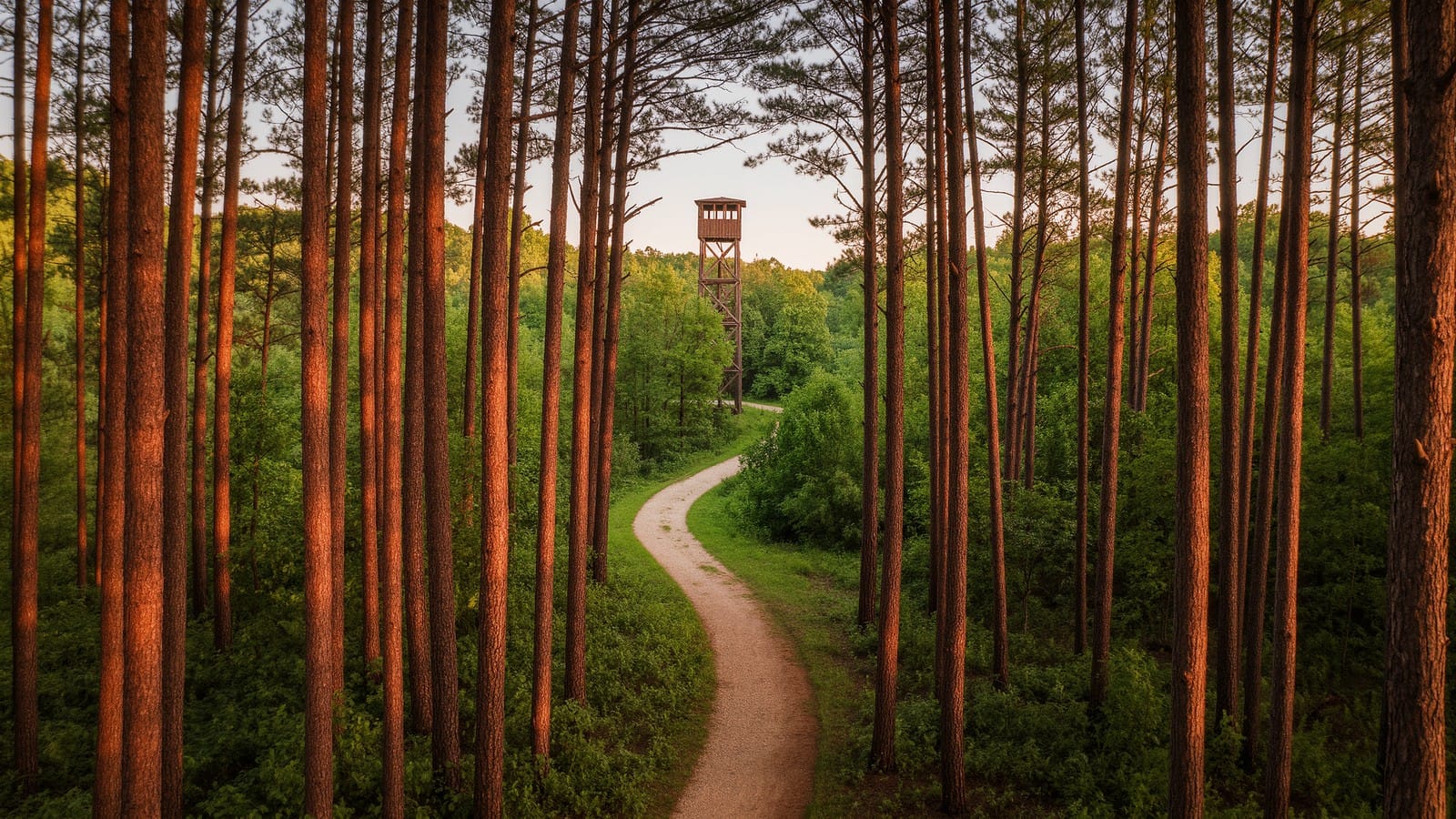
Tar Hollow State Park is one of Ohio's most remote hikes: a climbable fire tower, the 15-mile Logan Trail, and miles of quiet ridge-and-hollow forest.
Great Seal State Park: The Rugged Hills That Inspired the Ohio State Seal
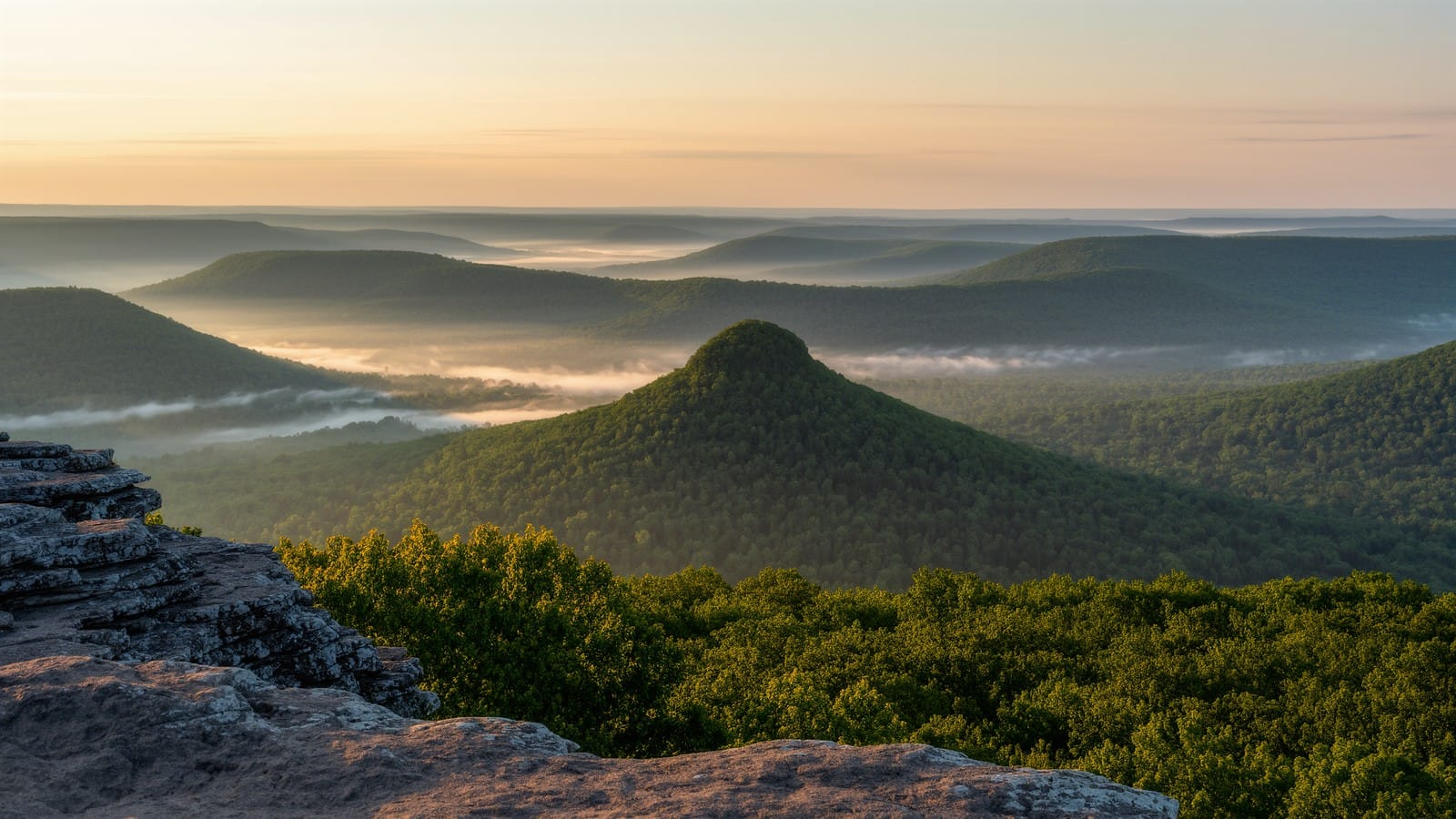
Great Seal State Park near Chillicothe hides Ohio's most rugged ridge hiking. Climb Sugarloaf Mountain to the view that inspired the state seal.